
Property Management Software Comparison
Property Management Software Alternatives (2026): A Practical Comparison Guide for Landlords and Growing Property Managers
In 2026, the property management software market has never had more options or more complexity. Platforms that look identical in a demo diverge significantly on total cost of ownership, accounting depth, maintenance workflow execution, and support quality under real operating conditions. For independent landlords and small property managers overseeing 1 to 100 units, the wrong choice does not just cost money. It costs time, creates operational blind spots, and eventually requires a migration at the worst possible moment. This hub connects to focused comparison guides for the platforms most commonly evaluated in 2026: Buildium, AppFolio, TurboTenant, and RentRedi. It also covers the evaluation criteria and pricing structures that determine whether a platform serves your portfolio at its current size and at the size you are building toward.
Property Management Software Alternatives (2026): A Practical Comparison Guide for Landlords and Growing Property Managers
In 2026, there are more property management software options than at any previous point, and more ways for those options to look better in a demo than they perform in practice. The market is projected to grow from $24.18 billion in 2024 to $52.21 billion by 2032, which means more all-in-one claims, more AI feature announcements, and more pricing complexity layered into plans that advertise a simple per-unit rate. For independent landlords and small property managers overseeing 1 to 100 units, the volume of choices is not the problem. The absence of a structured evaluation framework is.
Switching property management software is a scaling decision. A platform that handles 10 units without friction may require significant manual workarounds at 50. A platform priced attractively at your current unit count may become the most expensive option in your stack within 18 months once payment fees, add-on modules, and minimum monthly commitments are factored in. And a platform that wins the demo may reveal its limitations the first time you try to close a month, dispute a delinquency, or get a support response on a Friday night.
This hub connects to platform-specific comparison guides for the four alternatives most commonly evaluated by independent landlords and small property managers in 2026. It also covers the nine evaluation criteria that separate a confident software decision from a month of unstructured demos.
Why Landlords Are Switching Property Management Software in 2026
The most common reasons landlords and small property managers look for alternatives in 2026 are not about features. They are about four structural friction points that emerge as portfolios grow.
Cost unpredictability is the most frequently cited trigger. Advertised per-unit rates get offset by minimum monthly fees, payment processing charges for ACH and card transactions, and add-on modules for e-signatures, screening, and premium support. A platform priced at $1.49 per unit per month with a $298 monthly minimum costs significantly more per door at 50 units than the headline rate suggests. Building a 12-month total cost of ownership estimate before comparing platforms is the single most important step most landlords skip.
Maintenance workflow limitations are the second most common friction point. A platform can be strong at rent collection and lease management while leaving landlords to coordinate vendors through a separate inbox, track work order status in a spreadsheet, and chase down invoice documentation at month end. As unit count grows, maintenance coordination scales linearly with the number of units. A platform that cannot handle the full work order lifecycle from intake to invoice without manual intervention becomes more expensive to operate with every door added.
Accounting depth mismatches emerge as portfolios add complexity. The reporting that works for a landlord with five units frequently fails a property manager overseeing multiple owners, multiple entities, and multiple properties with different expense structures. Owner statement formats, trust accounting requirements where applicable, bank reconciliation workflows, and audit trails all become decision criteria that did not matter at the start.
Support quality under pressure is the criterion that is hardest to evaluate in a demo and most consequential in real operations. A support team that responds promptly to billing questions may route maintenance workflow questions to documentation links during a weekend emergency. Testing support quality through actual ticket submissions during the trial period is the only reliable evaluation method.
The Nine Criteria That Determine Platform Fit in 2026
1. Pricing and Total Cost of Ownership
Calculate effective cost per door at your current unit count and at your projected unit count in 12 months. Include the base subscription, estimated payment processing fees for your expected mix of ACH and card transactions, and every add-on module you will realistically use. The platform with the lowest subscription rate is rarely the lowest total cost.
2. Automation Matched to Repeatable Workflows
Automation creates return on investment through fewer late-rent follow-ups, fewer manual ledger entries, and fewer maintenance requests that fall through the cracks. AI adoption among property managers reportedly rose from 20% in 2024 to 58% in 2025, reflecting how quickly teams are moving repetitive work into automated workflows. The evaluation question is not whether a platform has automation. It is whether the specific automations it offers handle partial payments, mid-month pro-ration, and portfolio exceptions without requiring manual correction.
3. Tenant Communication as a Documented Function
Tenant communication in 2026 is not just sending messages. It is controlling volume, maintaining a record of every notice served, and reducing the back-and-forth that consumes leasing and maintenance team time. Evaluate whether the platform's communication tools create documentation as a byproduct of normal operations rather than requiring additional steps to build a paper trail.
4. Maintenance Workflows Built for Field Execution
The diagnostic question is simple: can you manage a maintenance request from first report to invoice without opening your email inbox? If the answer is no, that gap becomes more expensive with every unit added. Evaluate the full lifecycle: tenant intake with photo and video attachment, triage and categorization, vendor assignment with work order tracking, approval routing for cost thresholds, status updates to the resident, and cost tracking by property and unit.
5. Accounting Fit for Your Portfolio Complexity
Define whether your operation needs landlord bookkeeping or property management accounting before evaluating accounting features. Landlord bookkeeping requires clean income and expense reporting, rent receipts, and straightforward bank reconciliation. Property management accounting requires trust accounting where applicable, management fee tracking, owner distributions, and audit-friendly controls across multiple owners and entities. Do not accept a general claim that a platform has accounting. Require a demonstration of the specific reports you rely on using data that reflects your actual chart of accounts.
6. Usability and the Real Cost of Onboarding
Familiarity with a current platform creates an overestimation of switching cost and an underestimation of the cost of staying. A practical usability test during any trial: give a team member a checklist covering adding a unit, creating a lease, taking a payment, opening a maintenance ticket, and running a delinquency report. Time it, track how many times they ask for help, and repeat the test on two platforms. If your operations depend on one power user who understands the current software, you do not have software infrastructure. You have a single point of failure.
7. Integrations and Data Control
Define your non-negotiable tools before evaluating integrations. A platform that forces you to rebuild your technology stack may cost more in time than it saves in subscription fees. Confirm whether integrations are two-way syncs or one-time data pushes, and confirm whether you can export all critical data including leases, ledgers, contacts, and documents in a usable format if you need to migrate.
8. Compliance and Risk Documentation
Software cannot replace legal advice, but it can reduce compliance risk by creating a consistent documentation trail as a byproduct of normal operations. Evaluate whether the platform maintains audit logs for sensitive actions, stores notices and lease documents tied to the lease record rather than separately, and supports role-based permissions that control who can edit ledgers, waive fees, or change banking information.
9. Support Quality During Real Conditions
Test support during the trial period by submitting questions that require substantive answers across at least three categories: a billing question, an accounting workflow question, and a maintenance scenario with a time-sensitive component. Measure response time and the quality of the answer. A support team that provides documentation links in response to specific operational questions will provide the same experience at 11 p.m. on a Sunday when a payment fails.
Platform-Specific Alternative Guides for 2026
Buildium Alternative Guide
Buildium is one of the most widely used platforms for independent landlords and small property managers, with a customer base reported at more than 20,000 companies and over one million units. The decision to look for an alternative is rarely about Buildium being inadequate for the workflows it was designed for. It is typically driven by cost predictability as unit count and transaction volume grow, accounting reporting that does not fit more complex portfolio structures, maintenance mobile workflow friction, and support responsiveness during incidents.
This guide covers eight decision-stage criteria for evaluating any Buildium alternative in 2026, including a scored evaluation checklist and specific demo tests for each category.
AppFolio Alternative Guide
For mid-market portfolio operators, AppFolio works until the combination of minimum monthly fees, onboarding costs, resident payment friction, and reporting limitations raises the total cost of ownership above the value the platform delivers. The guide provides a six-step framework covering total cost of ownership calculation, accounting depth pressure testing, automation evaluation, reporting requirements, integration scoring, and support and onboarding validation, including a weighted scorecard and migration sequencing guidance.
TurboTenant Alternative Guide
TurboTenant's free plan covers the core steps of self-managing rentals and works well for landlords managing one to ten units with limited maintenance volume. The decision to evaluate alternatives in 2026 is usually driven by time cost rather than feature gaps: maintenance coordination that cannot scale, reporting that requires manual exports for tax preparation, and support that responds in days rather than hours. This guide covers seven evaluation steps including a copy-and-use evaluation checklist organized by category.
RentRedi Alternative Guide
RentRedi's flat pricing structure offers cost predictability at small portfolio sizes that per-unit pricing models rarely match. As portfolios grow in 2026, the evaluation shifts to whether the platform's automation, accounting, and maintenance workflows scale without significant manual workarounds. The guide covers the same nine evaluation criteria applied to RentRedi's specific feature set and pricing structure.
What Landlords and Property Managers Report in 2026
Software return on investment in property management in 2026 comes from three sources: fewer manual touches, faster resolution cycles, and better visibility that surfaces problems before they become expensive.
For a self-managing landlord with 12 units, the shift from spreadsheets and text messages to a software platform typically produces measurable savings through avoided late-fee processing errors, maintenance items that previously went undocumented and unbilled, and bookkeeping time recaptured at tax season. Industry data indicates that 43% of small landlords who adopt rental property software report measurable cost savings in these categories.
For a property manager at 300 units growing faster than staff, the shift to a more capable platform means maintenance workflows standardize across the portfolio, accounting becomes audit-ready with consistent property-level reporting, and leasing follow-up stops depending on individual memory. Industry reporting shows 94% of property management companies expect revenue growth over the next two years, with technology adoption consistently positioned as the primary lever for supporting that growth without proportional headcount increases.
The most common miscalculation in both scenarios is evaluating whether a feature exists rather than whether it executes reliably under real conditions. The right evaluation question in 2026 is not "does this platform have a maintenance module?" It is "can you show me a maintenance request going from tenant submission to vendor invoice to owner chargeback in under five minutes without leaving the platform?"
Frequently Asked Questions
What criteria matter most when comparing property management software alternatives in 2026?
The most reliable criteria are tied to daily workflows and financial controls rather than feature breadth. For landlords managing under 20 units, the highest-weight categories are automation covering reminders and late fee rules, payment processing including autopay and partial payment handling, and accounting that exports cleanly for tax preparation. For property managers overseeing more than 100 units, the highest-weight categories are accounting controls, reporting that supports multiple stakeholders, integrations, and support quality during close and during incidents.
How do I calculate true total cost of ownership for a property management platform?
Start with the base subscription, then add estimated payment processing fees for your expected mix of ACH and card transactions, and every add-on module you will realistically use including e-signatures, tenant screening, and premium support. Calculate the effective cost per door by dividing the total monthly cost by your unit count, then model it at your projected unit count in 12 months. The platform with the lowest subscription rate is rarely the lowest total cost once payment fees and required add-ons are included.
What should I test during a property management software trial in 2026?
Run the three workflows that determine whether a platform delivers on its promises: collect one payment including a partial payment scenario, create and resolve two maintenance tickets from tenant submission through vendor invoice, and generate one report covering rent roll and delinquency. Also submit two to three support tickets across different categories and measure response time and answer quality. If those workflows are smooth and support is responsive, the platform is likely to perform well in real operations.
When does it make sense to switch property management software?
Switching makes sense when a specific operational friction point is consuming measurable time every month and a platform change would eliminate it. The most common triggers in 2026 are cost that has grown unpredictably as unit count increased, maintenance coordination that requires significant manual workarounds outside the platform, accounting reporting that cannot produce the outputs owners or auditors require, and support that does not respond adequately during time-sensitive situations.
How long does a property management software migration typically take?
For portfolios in the 1 to 100 unit range, a structured migration typically takes four to eight weeks depending on data cleanliness and whether a parallel accounting close is required. The minimum viable migration set is properties and units, tenants, leases, ledgers, vendors, open balances, and current-year transactions. Validate reporting outputs against your current system before closing the parallel run. Migrating everything at once under time pressure is the most common source of migration problems.
Ready to see how Shuk compares on the criteria that matter most for landlords and property managers managing 1 to 100 units in 2026? Book a demo and walk through rent collection, maintenance workflows, lease renewals, and owner reporting with your specific portfolio in mind.
{
"@context": "https://schema.org",
"@type": "FAQPage",
"mainEntity": [
{
"@type": "Question",
"name": "What criteria matter most when comparing property management software alternatives in 2026?",
"acceptedAnswer": {
"@type": "Answer",
"text": "The most reliable criteria are tied to daily workflows and financial controls. For landlords managing under 20 units, the highest-weight categories are automation covering reminders and late fee rules, payment processing including partial payment handling, and accounting that exports cleanly for tax preparation. For property managers overseeing more than 100 units, the highest-weight categories are accounting controls, reporting that supports multiple stakeholders, integrations, and support quality during close and incidents."
}
},
{
"@type": "Question",
"name": "How do I calculate true total cost of ownership for a property management platform?",
"acceptedAnswer": {
"@type": "Answer",
"text": "Start with the base subscription, then add estimated payment processing fees for your expected mix of ACH and card transactions, and every add-on module you will realistically use. Calculate the effective cost per door by dividing the total monthly cost by your unit count, then model it at your projected unit count in 12 months. The platform with the lowest subscription rate is rarely the lowest total cost once payment fees and required add-ons are included."
}
},
{
"@type": "Question",
"name": "What should I test during a property management software trial in 2026?",
"acceptedAnswer": {
"@type": "Answer",
"text": "Run three workflows: collect one payment including a partial payment scenario, create and resolve two maintenance tickets from tenant submission through vendor invoice, and generate one report covering rent roll and delinquency. Also submit two to three support tickets across different categories and measure response time and answer quality. If those workflows are smooth and support is responsive, the platform is likely to perform well in real operations."
}
},
{
"@type": "Question",
"name": "When does it make sense to switch property management software?",
"acceptedAnswer": {
"@type": "Answer",
"text": "Switching makes sense when a specific operational friction point is consuming measurable time every month and a platform change would eliminate it. The most common triggers in 2026 are cost that has grown unpredictably as unit count increased, maintenance coordination requiring significant manual workarounds, accounting reporting that cannot produce required outputs, and support that does not respond adequately during time-sensitive situations."
}
},
{
"@type": "Question",
"name": "How long does a property management software migration typically take?",
"acceptedAnswer": {
"@type": "Answer",
"text": "For portfolios in the 1 to 100 unit range, a structured migration typically takes four to eight weeks depending on data cleanliness and whether a parallel accounting close is required. The minimum viable migration set is properties and units, tenants, leases, ledgers, vendors, open balances, and current-year transactions. Validate reporting outputs before closing the parallel run."
}
}
]
}
Shuk helps landlords and property managers get ahead of vacancies, improve renewal visibility, and bring more predictability to every lease cycle.
Book a demo to get started with a free trial.
The following guides cover every dimension of property management software evaluation in 2026: how to compare platforms at the decision stage, what total cost of ownership actually looks like when payment fees and add-ons are included, how to evaluate maintenance workflows and accounting depth in a demo, and when a specific platform's limitations make an alternative worth considering. Together they give independent landlords and small property managers a repeatable framework for selecting software based on operational fit rather than demo polish.
.webp)
Avail Alternative: A Practical Guide to Vacancy Prevention
A vacancy does not just pause income. It creates a cascade of urgent decisions. One unexpected move-out can trigger rushed repairs, last-minute showings, pricing pressure, and a scramble to rebuild your tenant pipeline from scratch. For independent landlords managing 1 to 100 units, that risk compounds quickly because you are often the leasing team, the bookkeeper, and the maintenance coordinator simultaneously. When a lease ends and you do not know the renewal answer until the final weeks, you are managing your business with incomplete information, and that is expensive.
Many landlords consider Avail because it is widely reviewed as intuitive and cost-effective, particularly for DIY owners who want online rent collection, applications, screening, and basic maintenance tracking in one place. Avail's listing syndication across large marketplaces and its straightforward workflow can be a strong starting point for smaller portfolios. Independent reviews also flag pain points that matter specifically to landlords who want to avoid renewal surprises: reduced lead volume after listing feed changes, limited renewal and lease management automation, and faster payouts gated behind higher-priced tiers.
Shuk is built around a different priority: preventing avoidable vacancy through early signals, proactive retention workflows, and year-round marketing. Instead of treating renewal as a calendar reminder, Shuk is designed to help you predict renewal likelihood months ahead, act sooner, and keep occupancy stable with transparent flat pricing of $5 per unit per month and white-glove onboarding support geared to independent landlords.
If you are tired of learning about a non-renewal when it is already too late to protect your cash flow, this guide is your practical comparison framework.
What This Guide Covers
Property management software is not just a tool for digitizing rent payments and storing leases. For independent landlords, the right platform becomes a decision system: it shapes how early you see risk, how consistently you follow up, and how quickly you can replace income when something changes. When workflows are fragmented across separate systems for payments, listings, lease expirations, and maintenance, the weak spot is almost always the same: renewals and vacancy timing.
Avail earns strong usability marks in independent review roundups and is frequently described as intuitive with a short learning curve. It typically fits DIY landlords managing roughly 1 to 10 units who want a lightweight way to handle listings, applications, screening, e-signing, and rent collection. Reviewers and landlord communities also describe limitations that become expensive as portfolios grow: marketing exposure tied to syndication feeds that can change, gaps in renewal automation for bulk rent increases or complex portfolio lease management, and faster payouts requiring a paid tier upgrade.
Shuk's positioning is narrower and more operational: vacancy prevention and tenant retention predictability. Its differentiators center on machine-learning-driven renewal insights, year-round listing and pipeline building rather than only marketing when a unit is vacant, and a two-way review system that encourages accountability and better-fit matches over time. It also emphasizes transparent flat-rate pricing and premium onboarding to reduce setup friction for busy owners.
Step-by-Step: How to Choose Software That Reduces Vacancy Risk
Step 1. Start With Your Real Business Goal: Fewer Surprise Vacancies, Not More Features
A common trap is evaluating software the way you would shop for a printer: compare a long list of capabilities and pick the one with the most boxes checked. But the expensive problem for most independent landlords is not a missing feature. It is timing risk: discovering a tenant will not renew when you have no runway to market, schedule turns, or adjust pricing.
Avail is often described as a broad, approachable toolkit covering rent collection, screening, leasing, and maintenance requests. That breadth can be ideal if your biggest pain is paperwork or accepting payments online. If your pain is renewal uncertainty, you need to evaluate whether the platform changes your outcomes, not just your process.
Shuk is designed around that outcome, providing early lease renewal insights up to six months before lease end and using predictive signals to help landlords plan. That matters because two months of notice is not the same as six months of visibility.
Scenario A: You manage 12 units and one tenant gives non-renewal notice 35 days out. You now have to coordinate cleaning, paint, showings, and screening in the tightest possible window, often while working another job.
Scenario B: You manage 40 units and learn three tenants are likely non-renewals in the same month, but only after the clock is already running. Your leasing bandwidth collapses and you discount rent to fill quickly.
Scenario C: You manage 6 units remotely. Even a single vacancy means coordinating vendors and showings from a distance, and a late surprise forces you into expensive, rushed decisions.
Rank software by whether it creates runway, not by whether the feature list is longer.
Step 2. Compare Marketing Philosophy: Syndicate When Vacant Versus Market Year-Round
Many platforms treat marketing as a vacancy event: post the listing when the unit is empty or about to be, and push it to marketplaces. Avail is known for marketing syndication to large listing networks. For many landlords, that broad exposure without manually posting everywhere is the primary reason Avail makes the shortlist.
The risk is that listing syndication feeds can change, and Avail's lead volume was notably affected after Zillow syndication changes, which forced some landlords into manual listing workarounds or platform switching. That is not just an inconvenience. It is a pipeline risk, because your marketing effectiveness becomes dependent on external channels you do not control.
Shuk emphasizes year-round marketing and proactive pipeline building so you are not starting from zero the moment a tenant hints they might leave. Instead of listing once a unit is vacant, the goal is keeping demand warm, particularly for higher-quality units and longer-term tenant relationships.
Scenario A: A landlord in a suburb relies heavily on one marketplace for leads. When syndication changes, applications drop sharply and days on market rise.
Scenario B: A small manager has strong properties but limited time. They post late, respond late, and miss the best applicants, so vacancy lasts longer than it should.
Scenario C: A landlord with 25 units prefers stable long-term tenants over the highest possible rent. A year-round pipeline helps them choose fit over urgency.
Ask yourself: if your best marketing channel underperforms this quarter, does your software help you recover quickly, or does it only show you the problem after it has already cost you?
Step 3. Treat Renewal as a Workflow and Demand Prediction, Not Just Reminders
Most landlords already know when leases end. The real challenge is knowing who is likely to renew and what to do early enough to influence the outcome. Avail provides digital leasing with templates and e-signatures, but reviewers cite limitations in renewal and lease management automation, particularly for bulk rent increases or complex portfolio renewal handling.
Shuk's differentiator is explicit: predictive lease renewal insights driven by machine learning models designed to surface risk earlier and reduce vacancy stress. In practice, this changes the questions you can ask.
Which tenants look stable and likely to renew if service levels stay high? Which tenants show risk signals that warrant an early retention conversation? Where should you begin quiet marketing to avoid a cold start?
Scenario A: A tenant who always pays on time begins submitting more maintenance tickets and asks about month-to-month options. A basic system logs the tickets. A predictive system flags retention risk and prompts an early renewal conversation.
Scenario B: You plan a modest rent increase but would rather keep a reliable tenant than push too hard. A renewal likelihood signal helps you tailor the offer between an increase, a longer term, or a unit upgrade.
Scenario C: A tenant is likely to renew, so you schedule non-urgent improvements after they re-sign rather than disrupting them before the decision is final.
Choose software that does not just track lease dates. Choose software that helps you act before the renewal decision is made.
Step 4. Add Accountability With a Two-Way Review System
Independent landlords often learn the hard way that screening is not only about credit and background. It is also about expectations and behavior. Avail's screening is TransUnion-backed and priced per applicant, covering standard credit, criminal, and eviction data. That is valuable for answering whether an applicant is risky on paper.
Shuk adds a different lever: a two-way tenant and landlord review system designed to increase transparency and accountability on both sides. The purpose is not to rate people for its own sake. It is to create better matches and fewer avoidable conflicts that lead to non-renewals.
Scenario A: A tenant with decent credit repeatedly violates quiet hours and frustrates neighbors. Traditional screening will not reveal this pattern. Behavioral transparency over time can.
Scenario B: A landlord has excellent housing but slow maintenance response times. Two-way reviews create feedback loops that improve service, which reduces move-outs driven by frustration rather than financial necessity.
Scenario C: A tenant wants a responsive, low-drama rental experience. Reviews help them identify a landlord who fits, which reduces early churn for both parties.
For retention, fit matters as much as financial qualification. Software that supports structured feedback improves long-term stability in ways that credit screening alone cannot.
Step 5. Understand Total Cost: Transaction Fees, Payout Speed, and Pricing Predictability
Landlords frequently underestimate the hidden economics of software: payment fees, tiered features, and the cost of upgrading tiers to get basic operational speed. Avail offers a free tier with per-transaction fees typically around $2.50 per ACH and card fees around 3.5%, while faster payouts and fee-free setups require the paid tier. Independent pricing data shows the paid tier cost rising to approximately $9 per unit per month in 2026.
Shuk's pricing is positioned as transparent flat-rate at approximately $5 per unit per month with rapid payouts in one to two days and no hidden fees, plus potential volume discounts for larger portfolios. For landlords managing 20 to 100 units, predictability can matter as much as the absolute number, particularly when your goal is to budget for operations while reducing vacancy risk.
Scenario A: A landlord chooses a free platform, but ACH fees accumulate across 30 units and they still need a paid upgrade for faster cash flow.
Scenario B: A landlord passes fees to tenants. Tenants resent it, satisfaction drops, and non-renewal risk increases.
Scenario C: A landlord with 60 units wants one consistent per-unit cost without surprise tier changes as the portfolio grows.
Compare effective monthly cost at your unit count, including payout speed and the features you actually need for retention, not only the headline entry price.
Step 6. Evaluate Onboarding and Consolidation
Even strong features fail if they are not implemented consistently. Avail is frequently praised for ease of use and a short learning curve, which reduces adoption friction. But as portfolios grow, easy can still become fragmented if renewals, marketing, messaging, and maintenance live in partially connected workflows.
Shuk emphasizes premium white-glove onboarding including property setup and tenant onboarding support, with the goal of getting landlords to a stable, repeatable workflow quickly. Consolidation matters because vacancy prevention is not a single action. It is a cadence: monitor renewal risk, message early, market continuously, and convert leads smoothly.
Scenario A: You migrate mid-year and worry about losing documents. Guided setup reduces the I-will-do-it-later delay that leaves you exposed during peak lease-end months.
Scenario B: Your team is you and one other person. If the platform is not used consistently, renewals slip. A structured workflow prevents spreadsheet drift.
Scenario C: You manage 80 units and want a single source of truth for tenant communication. Consolidation reduces missed messages that can sour relationships before renewal conversations even begin.
Evaluate not just software features but your likelihood of using them every week, because retention is operational, not theoretical.
Software Comparison Checklist: Vacancy Prevention Edition
Renewal predictability: Does the platform show renewal likelihood or risk signals months in advance rather than only tracking lease dates? Does it support a structured renewal workflow with prompts, follow-ups, and offer tracking? Does it help segment tenants into stable, uncertain, and likely-move categories to prioritize outreach?
Marketing resilience: Is marketing independent of a single syndication feed that could change? Does the platform support year-round pipeline building rather than only activating when a unit is vacant? Is lead handling fast and organized so strong applicants are not missed?
Tenant quality and fit: Is screening credible and consistent covering credit, criminal, and eviction data where legally permissible? Does the platform evaluate fit and expectations beyond financial qualification? Does it promote accountability for both parties to reduce conflict-driven churn?
Pricing clarity: Is per-unit pricing clear and forecastable for 12 months? Are fast payouts available without requiring an expensive tier upgrade? Do transaction fees stay manageable at your unit count?
Implementation confidence: Does onboarding include guided setup and migration support? Does the platform consolidate key workflows covering leasing, maintenance, messaging, and documents? Is the workflow one you can imagine using every week without workarounds?
How to use this checklist: Identify your top two priorities. Most landlords choose renewal predictability and marketing resilience. Any platform scoring below 6 out of 10 in those two categories is likely to preserve your vacancy stress even if it scores well on a feature list.
Frequently Asked Questions
If I am using Avail today, when does it make sense to switch?
Switch when your biggest cost is no longer administrative time but surprise vacancy. Avail is widely described as a strong, intuitive starter tool for DIY landlords, particularly for listings, leasing, and payments. Independent reviews also point to gaps in renewal-centric automation and shifting marketing exposure as syndication feeds change. If you have had even one non-renewal notice that arrived too late to protect your pipeline, that is a clear signal to evaluate software built around early renewal insight and year-round marketing.
What about migrating data including leases, tenant information, and payment history?
Migrate in phases. Move property, unit, and tenant records and documents first, then align lease-end dates and renewal timelines, then switch rent collection at the start of a new month. Shuk emphasizes premium onboarding and setup support to reduce migration friction and keep operations stable during the transition. For landlords managing 30 to 100 units, guided setup can be the difference between a smooth cutover and months of running parallel systems unnecessarily.
How do I compare pricing fairly when Avail has a free tier?
Compare effective monthly cost at your unit count, not the entry price. Avail's free tier includes per-transaction fees, and faster payouts are tied to the paid tier. Independent pricing data shows the paid tier rising to approximately $9 per unit per month in 2026. Shuk positions pricing at a flat $5 per unit per month with rapid payouts and no hidden fees. At 1 to 5 units, a free tier can be compelling. At 20 to 100 units, fee accumulation, payout speed, and the need for retention-focused tooling often make predictable pricing more valuable than free to start.
Are renewal predictions accurate enough to rely on?
Treat prediction as an early-warning system, not a guarantee. The business value is runway: seeing which leases need attention early so you can start conversations, plan renewal offers, and begin quiet marketing before you are under time pressure. Even with imperfect accuracy, which all predictive models carry, a tool that helps you prioritize outreach and avoid last-minute scrambles can materially reduce vacancy risk compared to purely calendar-based reminders. A tenant predicted to renew who ultimately moves due to a job change is less damaging when you had early visibility and a pipeline already building.
If you want to see how Shuk's predictive lease renewal insights, year-round marketing, two-way review system, and transparent flat pricing work for landlords managing 1 to 100 units, book a demo and bring your lease expiration calendar. A good walkthrough should show you within minutes how the platform flags renewal risk, prompts early outreach, and keeps leads warm before the next vacancy becomes urgent.
.webp)
TenantCloud Alternative: Why Shuk Works for 1 to 100 Units
A vacancy is not just one month without rent. It is lost time, uncertainty, and a cascade of expenses that can erase the gains from a rent increase. Nationwide average vacant days reached approximately 34.4 days by the end of 2024, up from roughly 30 days in early 2020. Once a tenant leaves, the full turnover event can cost $2,000 to $5,000 depending on vacancy loss, repairs, and administrative work. For a small landlord managing 6 to 40 units, even a couple of preventable move-outs can materially change the year's cash flow.
That is the real backdrop for choosing property management software. You are not shopping for an app. You are shopping for fewer vacancy days, higher renewal rates, and less time chasing payments, messages, and maintenance updates.
TenantCloud is a broad, all-in-one platform built to cover many workflows for many portfolio types: accounting, leasing, maintenance, portals, and integrations. Shuk takes a different approach, purpose-built for 1 to 100-unit landlords who want predictive lease renewal insights, simple operations, and transparent pricing so you can act early to keep good tenants and stabilize income.
This guide compares both platforms through the lens that matters most to small portfolios: renewal risk, vacancy prevention, learning curve, total cost of ownership, and support.
Two Different Philosophies: Specialization Versus Comprehensiveness
TenantCloud is the comprehensive platform. It is positioned as an all-in-one system covering rent collection, maintenance requests, tenant screening, leasing, accounting, communication, and reporting, with portals and integrations including QuickBooks. It offers multiple pricing tiers and is designed to scale from small landlords to firms managing 250 or more units. That breadth matters if you need many modules under one roof and are willing to trade simplicity for coverage.
Shuk is the small-portfolio specialist. Instead of covering every use case, Shuk focuses on insight-driven operations for 1 to 100 units, with an emphasis on predictive lease renewal insights that flag renewal risk early so you can intervene before notice is given, two-way reviews that improve fit and accountability between landlords and renters, and transparent pricing without the add-on stack that makes comprehensive platforms expensive at small scale.
Why does this distinction matter? National renewal rates have improved, with over 54% of renters renewing as of late 2024, but that still means nearly half may turn over. Industry data suggests 40% of renters would renew if maintenance felt more responsive, tying retention directly to operational execution rather than rent pricing. The best tool for a small portfolio is the one that helps you spot renewal risk early and run a tight, responsive operation without adding administrative overhead.
How to Choose Between TenantCloud and Shuk for 1 to 100 Units
Step 1. Start With the Real KPI: Vacant Days Prevented, Not Features Included
Your platform should reduce the two costs you feel most immediately: vacancy time and turnover expense. If your typical unit takes a month to re-rent, the difference between reactive and proactive can be one to two weeks of rent per turnover, plus the hidden time cost of showings, follow-ups, and vendor coordination.
TenantCloud gives you broad operational tools covering listings, leasing workflow, payments, maintenance tracking, and accounting. This can reduce vacancy by improving execution once a move-out is already happening, through better marketing, applications, screening, and lease signing.
Shuk is built for prevention first. Predictive renewal insights help you act before a move-out becomes a vacancy by identifying tenants trending toward non-renewal and prompting timely interventions.
Example 1: A 12-unit landlord calculates that the last two turnovers cost roughly $3,500 each in repairs, cleaning, and lost rent. TenantCloud helps organize the make-ready checklist and leasing process. Shuk reduces how often that checklist is needed by surfacing renewal risk earlier.
Example 2: A manager juggling 40 doors cannot afford to discover non-renewals at day 30. A predictive signal at day 120 creates time to address the real issue before the decision is already made.
In demos, ask each vendor: what does the product do in the 90 to 180 days before lease end to reduce move-outs? If the answer is primarily reminders, you are still operating reactively.
Step 2. Evaluate Renewal Intelligence: Reminders Versus Predictive Insight
With renewal rates above 54% nationally, your software advantage comes from capturing the tenants who would stay if you solved the right problem at the right time. The data point that maintenance responsiveness influences 40% of renewal decisions is a direct operational instruction: retention is not primarily about rent pricing. It is about execution.
TenantCloud covers the full lifecycle including leases, e-signatures, portals, maintenance requests, communication, and accounting. Broad platforms typically depend on the operator to interpret signals and run their own retention playbook.
Shuk translates activity and engagement patterns into a renewal risk view and guides the landlord on next steps rather than leaving interpretation to the operator.
Example 1: A tenant submits multiple maintenance requests in a short period. TenantCloud logs the requests. Shuk treats the pattern as a renewal risk factor and prompts a proactive check-in and resolution plan.
Example 2: A resident pays on time but stops responding to messages and ignores renewal outreach. Traditional tools show that messages were sent. Predictive renewal insight identifies the behavior cluster as a precursor to non-renewal and creates a window for intervention.
Whatever platform you choose, build a monthly renewal risk routine that reviews leases expiring in 120, 90, and 60 days alongside a plan for maintenance follow-through, rent options, and relationship repair.
Step 3. Match the Platform to Your Maintenance Reality
Maintenance is consistently identified as the biggest operational stressor for rental owners, frequently cited in the 38% to 61% range across industry surveys depending on segment. Cost inflation, vendor delays, and staffing shortages make quick resolution harder, yet responsiveness is a primary driver of renewals.
TenantCloud offers maintenance request tracking and tenant portals as part of its broad toolkit, helping to centralize requests, attach photos, and document work, which is particularly useful when managing multiple properties.
Shuk connects maintenance responsiveness directly to renewal outcomes through insight and guided action rather than leaving the operator to draw that connection on their own.
Example 1: A 25-unit operator uses TenantCloud to capture requests and invoice tracking but still loses tenants because issues feel unresolved. Shuk measures responsiveness including time to acknowledge, time to schedule, and time to completion, and highlights units at risk when service levels slip.
Example 2: A 6-unit landlord relying on two vendors and waiting for callbacks. TenantCloud can log the issue. Shuk's small-portfolio focus means simpler workflows and clearer guidance for landlords who do not have the bandwidth to build a maintenance management system from scratch.
During your software trial, test one full maintenance cycle end to end from request through acknowledgment, vendor assignment, completion, and resident follow-up. Then evaluate which platform makes it easiest to demonstrate responsiveness, because responsiveness correlates directly with renewal willingness.
Step 4. Compare Total Cost of Ownership for Under 100 Units
Monthly subscription price is only part of the story. For small portfolios, unexpected costs come from add-ons, payment processing fees, or being pushed to a higher pricing tier sooner than anticipated.
TenantCloud publicly lists plans including Starter at $15 per month and Growth at $50 per month, with a Business tier for larger operators. User discussions and review platforms frequently cite pricing changes and fee-related friction as recurring pain points as portfolios grow or operators add features.
Shuk offers transparent pricing for 1 to 100 units with fast deposits and ACH-free rent collection. For a small landlord collecting dozens of payments monthly, removing ACH fees is a material cost difference rather than a minor convenience.
Example: A 50-unit landlord comparing platforms over 24 months finds that TenantCloud looks inexpensive on Starter but requires an upgrade for team features, accounting sync, or additional storage as complexity grows. Shuk's value proposition is that managing a small portfolio well should not require accumulating paid add-ons over time.
Build a total cost of ownership table before committing that covers subscription fees, payment processing costs, add-ons you will realistically need by month six, and an honest estimate of the time cost to configure and train yourself or staff. The cheapest headline plan can become the most expensive option if it increases administrative load.
Step 5. Decide How Much Complexity You Can Actually Sustain
Comprehensive platforms often win feature comparisons. Specialist platforms often win on adoption and daily use. TenantCloud is frequently praised for being feature-rich and improving its interface over time, but reviews also note navigation issues, occasional glitches, and variable support responsiveness. For a time-constrained operator, any friction in the platform becomes a delay in responding to tenants, which is exactly the thing that puts renewals at risk.
TenantCloud is best when you want a broad set of modules in one system and can invest the time to configure workflows, permissions, and accounting integrations across your portfolio.
Shuk is best when you want the shortest path from identifying what you need to do to having it done, particularly around renewals and vacancy prevention where timing is the competitive advantage.
Example: An accidental landlord, a growing profile in slower sales markets where homeowners choose to rent rather than sell, wants to stop learning software and start stabilizing rental income. In that situation, specialization and guided support can beat comprehensiveness.
Measure learning curve with one practical test: can you onboard a tenant, collect first month's rent, and resolve a maintenance request in under 60 minutes of total setup time? If not, the tool may be more platform than your current stage requires.
Step 6. Choose the Platform That Improves Trust on Both Sides
Retention is partly math and partly relationship. When residents feel heard and problems are handled consistently, they stay longer, which directly reduces the turnover costs that industry data puts at $2,000 to nearly $4,000 per resident.
TenantCloud provides tenant portals, communication tools, e-signatures, and payment features designed for self-service and documentation.
Shuk differentiates with two-way reviews that create accountability on both sides of the landlord-tenant relationship and improve future placement quality over time. It also positions customer support around the realities of small portfolio management, where a single unresolved issue can consume an entire evening.
Example 1: A landlord inherits a difficult tenant and wants to avoid repeating the experience. Two-way reviews create a record of performance on both sides that improves screening and expectation-setting over time.
Example 2: A high-quality tenant wants confidence that payments post correctly and deposits arrive quickly. Both platforms support online payments. Shuk's emphasis on fast, ACH-free deposits is directly targeted at reducing payment-related friction and the tenant anxiety it creates.
Ask each vendor to describe their support path for small landlords, including response times, onboarding assistance, and what happens when a payment is delayed or a lease needs correction mid-cycle.
TenantCloud vs. Shuk Evaluation Checklist
Use this to score each platform from 1 to 5. The goal is fit, not a perfect score.
Vacancy and renewal prevention: Does the platform provide predictive renewal risk with recommended actions rather than only reminders? Can you see lease expirations at 180, 120, 90, and 60 days and run a structured renewal process? Can you track maintenance responsiveness and connect it to retention outcomes?
Core operations you will use weekly: Tenant payments, posting, receipts, and clear audit trail. Fast deposit speed with minimal payment friction. Maintenance request intake with photos, vendor notes, and status tracking. Applications, screening, and e-signature leases.
Pricing and total cost over 12 to 24 months: Plan fit at your current unit count. Plan fit at your projected unit count in six months. Transaction and add-on costs beyond the headline subscription. Cost per unit compared to turnover cost of $2,000 to $5,000 per event.
Complexity, adoption, and support: Time from signup to first tenant onboarded and rent collected. User experience quality and navigation clarity. Support channels and response times that match small portfolio operations.
Trust and tenant experience: Tenant portal quality covering payments, requests, and documentation. Two-way review capability to improve fit and accountability over time.
Final decision rule: Choose TenantCloud if you want a broad, configurable platform and expect to scale into heavier operations including portfolios above 250 units. Choose Shuk if you manage 1 to 100 units and want specialized, insight-driven renewal prevention with transparent pricing and ACH-free deposits.
Frequently Asked Questions
Can I migrate from TenantCloud to Shuk without disrupting rent collection?
Yes, if you treat migration as a controlled cutover rather than a simultaneous switch. Export your active leases, tenant contact information, and ledger history from the existing system, then run one full rent cycle in parallel before transitioning everyone. The key is to avoid changing payment instructions mid-cycle. Pick a date immediately after rent is collected, communicate the change clearly, and provide tenants a one-page guide explaining how to pay in the new system. If your primary motivation for switching is vacancy reduction, prioritize migrating lease dates and renewal timelines first because that is where proactive retention work begins.
What if I plan to grow beyond 100 units? Should I start with TenantCloud?
If you are confident you will need a broad, multi-module system and expect significant scaling, TenantCloud is explicitly designed for portfolios from small to 250 or more units. However, growth is not just about unit count. It is about process maturity. Many operators grow faster by stabilizing renewals and reducing turnover first, because each turnover event costs $2,000 to $5,000 and compounds across a growing portfolio. If Shuk's predictive renewal insights help you stabilize income earlier, you may reach your growth targets faster than a more complex platform would allow.
Which platform is better for accidental landlords or time-constrained owners?
Time-constrained owners typically need simple execution and guidance on what to prioritize. Accidental landlords, a growing profile in markets where homeowners rent rather than sell, generally benefit from a platform that encodes best practices rather than requiring the operator to design their own workflows from scratch. A specialist product built around predictive guidance can be easier to sustain than a platform with a wide configuration surface. TenantCloud can still work well if you are willing to invest in initial setup and prefer a comprehensive toolkit.
How do I know if predictive renewal insights will actually improve my renewal rate?
Treat it like any operational change: run a 90-day experiment. Identify leases expiring in 120 to 180 days, apply the recommended interventions including maintenance follow-up, proactive check-ins, and renewal options, and track outcomes. Industry data showing that 40% of renters say responsiveness would make them more likely to renew provides a plausible mechanism that goes beyond simply sending more messages. If your non-renewals correlate with unresolved maintenance issues or slow response times, predictive signals create the window to intervene before the decision is already made.
Ready to see how Shuk's predictive renewal insights, two-way reviews, and ACH-free rent collection work for landlords managing 1 to 100 units? Book a demo and walk through how the platform applies to your specific lease calendar and portfolio size.
RentRedi Alternative: A Decision Guide for Landlords and Small Property Managers
If you are searching for a RentRedi alternative, you have likely hit a familiar friction point: the platform still works, but the workaround list keeps growing. Rent collection happens, but deposits and fees need manual cleanup. Maintenance requests come in, but tracking vendor status and recurring issues feels scattered. You can produce a basic report, but month-end close still means exporting to spreadsheets, reconciling in a separate accounting tool, or asking your CPA to make sense of the numbers.
This is the quiet tax of outgrowing entry-level property management software: not a single catastrophic failure, but constant friction. That friction shows up as missed follow-ups, slower owner updates, inconsistently applied late fees, and financial records that do not match your bank. Over time it affects tenant experience and renewals because tenants increasingly expect online-first service. Industry research found that 95% of rental owners are comfortable doing business online, up notably year over year, meaning digital workflows are now a baseline expectation rather than a differentiator.
The upside is that switching software is more common than it used to be and the return on investment can be real. Research on small landlord operations suggests meaningful annual savings through automation, with reported ROI of 300% to 500% within the first year when automation genuinely replaces manual work. This guide gives you a structured seven-step framework to decide whether to stay put, upgrade your process, or move to the RentRedi replacement that fits your portfolio.
What to Compare and Why It Matters More Than Price
Alternatives to RentRedi span a wide range: some tools are landlord-first and lightweight, others are designed for property managers with complex accounting and compliance requirements. The mistake most operators make is comparing only the subscription price, or worse, comparing feature checklists without testing how those features work in real conditions like applying partial payments, handling chargebacks, or reconciling deposits.
A more useful approach is to evaluate software through the lens of your operating model.
Cash-flow accuracy: How confidently can you answer what you actually collected and what is still owed without spreadsheet work?
Maintenance workflows: Are requests trackable end to end from triage through assignment, vendor communication, invoice, and resident update?
Scalability: Will the system still feel clean at 50 doors, 150 doors, or 300?
Integrations: Can it connect to your bookkeeping, bank feeds, listing channels, and reporting tools, or do you re-enter data across systems?
Support: When rent is missing, you do not want a forum thread. You want a resolution path and clear accountability.
The market is moving quickly. The global property management software market was valued at $24.18 billion in 2024 and is projected to reach $52.21 billion by 2032, driven by cloud adoption and automation. More platforms and more features mean more reasons to be intentional about your stack rather than defaulting to whatever is cheapest.
Seven Steps to Choose the Best RentRedi Alternative
Step 1. Define Your Must-Win Outcomes Before Looking at Features
Before evaluating any property management software, define what better must mean for your business. Features are only valuable if they improve measurable outcomes.
Start with three buckets. Time savings: what tasks are consuming your week, whether that is leasing coordination, payment follow-up, maintenance coordination, or owner reporting? Financial accuracy: are you reconciling monthly and are you confident in your delinquency reporting? Tenant experience: tenants increasingly choose rentals based on the service experience, particularly tech-enabled convenience around payments, communication, and maintenance.
Write down five KPIs you want software to improve before you begin any demos. Examples might be closing books by the fifth of each month, reducing late rent follow-ups, or getting maintenance first responses under four hours. Use those KPIs as your scoring criteria rather than marketing claims.
Mini case study: Maria owns 15 units across two small buildings. Rent collection works, but month-end is consistently chaotic: she exports transactions, tags them in spreadsheets, and her CPA still finds mismatches at tax time. Maria's must-win outcome is not a new tenant portal. It is clean monthly books and a faster close process.
Step 2. Compare Rent Collection as a Cash-Flow System, Not a Payment Button
Rent collection is where small workflow gaps become significant cash-flow problems, especially when you scale beyond a handful of doors. When evaluating a RentRedi alternative, test the specific scenarios that expose platform weaknesses rather than the common case.
How does the ledger behave if a tenant pays half now and half later? Can you set late fee rules that reflect your actual lease terms including grace periods, caps, and one-time versus recurring charges? Are there options for ACH, debit, and credit, and do you control who pays the processing fees? Do payments post immediately or after settlement, and are pending versus completed amounts clearly distinguished? Does the platform automatically remind tenants of upcoming and overdue amounts, and can you log notices and document communications for compliance purposes?
Industry data suggests tenants who use online payment functions can be twice as likely to pay on time, which directly stabilizes cash flow. The best RentRedi alternative for your portfolio may simply be the tool that drives the highest tenant adoption of online payments with the least confusion.
Mini case study: Devin manages 80 units. He does not need sophisticated marketing tools. He needs fewer disputes over whether a payment was made. In every demo he asks vendors to show exactly where he would click to confirm payment status and how a reversed payment appears in the ledger. The platform that wins is the one that makes disputes rare and resolution fast.
During trials, run a mock rent cycle with at least three test scenarios covering on-time autopay, a late payer, and a partial payment. If you cannot simulate edge cases, you are making a purchasing decision without the information that matters most.
Step 3. Treat Screening, Leases, and Compliance as a Single Workflow Chain
Many landlords compare screening vendors and e-signature features in isolation. In practice, what matters is whether the system supports a consistent and defensible leasing process from first contact to signed lease.
Look for application pipeline visibility that shows where each applicant stands without manual tracking. Evaluate screening speed and audit trail quality, because digital screening that can shorten time-to-approve while maintaining consistency is directly tied to reducing vacancy loss. Confirm that the platform supports lease templates and standardized addenda so you are not emailing PDFs and tracking versions manually. Verify that the full chain from application through screening result through lease through notices is stored and retrievable for fair housing compliance or dispute documentation.
Example: A couple applying to Sam's duplex claims they were treated inconsistently compared to another applicant. Sam cannot prove his process because notes are scattered across texts and email threads. A stronger system would show time-stamped actions, consistent criteria, and stored communications that make the process reproducible and defensible.
Ask each vendor directly: show me what an audit trail looks like for an applicant from first inquiry to move-in.
Step 4. Evaluate Maintenance as Your Retention Engine
If rent collection is the cash-flow engine of your portfolio, maintenance is the retention engine. Industry reporting consistently emphasizes maintenance operations as a competitive advantage because it affects renewals, reviews, and operational cost control over time.
Evaluate intake: can tenants submit requests with photos, video, categories, and permission to enter? Evaluate triage: can you set rules distinguishing emergencies from routine requests and assign by property, unit type, or vendor specialty? Evaluate status tracking: does the tenant receive automatic updates, or does every response require a manual step from your team? Evaluate vendor coordination: can vendors receive assignments, message within the ticket, and upload invoices? Evaluate recurring maintenance: can you schedule preventive work like filter changes, inspections, and gutter cleaning?
Mini case study: Aisha manages 120 units and noticed renewals declining. Her internal review showed slow maintenance response was the most common complaint. After implementing a platform with clearer ticket status and automated tenant updates, her team reduced inbound status calls and improved response consistency across the portfolio.
Create a list of ten standard repairs you handle regularly, such as a leak, no heat, appliance issue, lockout, and pest complaint. In demos, require the software to demonstrate the full workflow for each from tenant request through vendor invoice through owner reporting. If the demo uses only the ideal case, push for the edge cases.
Step 5. Treat Accounting Complexity as the Most Common Outgrowing Trigger
Landlords often tolerate basic ledgers until something forces the issue: adding more properties and being unable to break out performance by asset, a CPA requesting cleaner books with fewer manual exports, or beginning to manage for others and needing owner statements and trust account discipline.
Property management accounting has specific requirements that general business accounting does not address. Security deposits must be tracked as liabilities rather than income, owner disbursements must be clearly separated, and reconciliation discipline is foundational to reliable reporting and compliance.
When assessing a RentRedi replacement on accounting capability, ask whether you can customize the chart of accounts or map it to your CPA's structure. Confirm whether bank reconciliation is supported within the platform or requires exporting to a separate tool. Verify that security deposits are tracked correctly as liabilities. Confirm whether professional owner statements are producible without manual Excel formatting. And if you maintain a separate bookkeeping system, confirm whether the integration is genuinely bidirectional or requires re-entry.
Example: Luis manages 40 units for family members and friends. He does not need enterprise-grade accounting, but he does need consistent monthly owner statements and a straightforward way to tag expenses by property. He selects a platform based on owner reporting clarity and reconciliation workflow rather than the lowest monthly subscription.
Bring your CPA into the evaluation before you make a final decision. Ask what reports they need each month, then test whether the platform produces those reports without manual manipulation.
Step 6. Compare Pricing Using Total Operating Cost, Not Subscription Cost
Software pricing for small landlords typically follows recognizable patterns: per unit per month, flat monthly tiers, or bundled service fees covering payments, screening, and listings. The trap is focusing exclusively on the base plan.
Build a complete cost view that includes subscription fees at your current and projected unit counts, transaction fees for payment processing and expedited deposits, add-on costs for additional users, e-signatures, maintenance modules, or advanced reporting, and an honest estimate of labor cost. A cheaper platform that requires six additional hours of admin work per week is not cheaper in any meaningful sense.
Mini case study: Priya has 22 units. She considered switching because her current platform's basic plan appeared affordable, but she was absorbing costs through payment-related fees and manual reporting time that did not appear in the subscription comparison. She built a one-page cost model across three scenarios: staying with her current setup and keeping manual reporting, staying and buying add-ons, and switching to a system with stronger accounting and reporting. The winning choice was not the cheapest plan. It was the plan that reduced admin time and produced cleaner books.
Build a one-page cost model with three rows covering software fees, payment and screening fees, and hours per week of admin work. Assign a conservative hourly value to your time and run the comparison honestly.
Step 7. Validate User Experience, Support, and Scalability Before You Commit
Switching tools is significantly less risky when you treat it as a controlled migration rather than flipping a switch. Problems tend to surface at peak stress moments: month-end close, renewal season, and maintenance emergencies.
Evaluate whether a non-technical team member could learn the platform in a day. Confirm whether role-based access allows you to restrict what vendors and assistants can see. Ask whether onboarding is documented and structured rather than ad hoc. Test support responsiveness across the channels you would actually use. Confirm that all key data including tenants, leases, ledger history, and maintenance records can be exported if you ever need to switch again.
A practical migration plan for a small to mid-size portfolio: choose a cutover date at the beginning of a month for simplicity, export all current data before canceling anything, reconcile your ledger before migration rather than carrying forward errors, run both systems in parallel for two to four weeks to verify rent posting and maintenance intake, and send tenants a clear communication explaining what is changing, when it takes effect, and where to pay and submit maintenance going forward.
Example: Ben manages 210 units. He does not migrate everything simultaneously. He pilots the new platform on 30 units for one full rent cycle, then rolls out in waves. The result is fewer payment questions, fewer support tickets, and a cleaner transition for tenants.
Do not start migration during your busiest operational period. Most operators prefer a calm month with limited lease expirations and a predictable maintenance load.
RentRedi Alternative Evaluation Scorecard
Use this to compare platforms consistently. Score each item 1 to 5 and add notes.
Business fit and outcomes: Estimated weekly admin time reduction in hours. Improvement to on-time payment rates through tenant adoption. Impact on month-end close speed and spreadsheet dependency. Support for current portfolio size. Support for projected growth over the next 24 months.
Rent collection and resident payments: Autopay, partial payments, and late fee rules work as expected. Payment status is clearly shown as pending, settled, or reversed. Fee controls are transparent between tenant-paid and landlord-paid. Delinquency tracking and automated reminders function correctly.
Leasing and screening workflow: Application pipeline view and status tracking available. Screening process is consistent and produces an auditable record. E-sign leases and standardized addenda are stored in the platform. Tenant communications are centralized with email and text logs.
Maintenance and vendors: Tenant requests support photos and permission-to-enter. Triage rules, assignment workflows, and status tracking are functional. Vendor messaging within tickets and invoice upload are supported. Recurring maintenance scheduling is available.
Accounting and reporting: Bank reconciliation is supported in-platform or through a clean integration. Security deposits are tracked as liabilities rather than income. Property-level reporting covering income, expenses, and delinquency is available. Owner statements are producible without manual formatting for third-party management.
Integrations, security, and support: Data export covers tenants, leases, ledger, and maintenance history. Role-based access for assistants and vendors is configurable. Support channels and response times meet your operational needs. Onboarding documentation and migration assistance are included.
Frequently Asked Questions
How much does it cost to switch to a RentRedi alternative?
Direct costs typically include new subscription fees and any implementation assistance if you choose onboarding support. Indirect costs are the staff time required to export and import data, clean up your ledger, and communicate the change to tenants. The break-even depends on how manual your current process is. If switching reduces admin work meaningfully, the costs of migration are typically recovered within the first few months of operation.
Will I lose transaction history or maintenance records during migration?
You should not, provided you export data before canceling anything and are deliberate about what you import versus archive. A practical approach is to import current tenant balances and active leases while keeping older maintenance history in an accessible archive file. Reconcile and clean your records before cutover rather than carrying forward errors into the new system.
Are property management platforms typically month-to-month or contract-based?
It varies by platform. Some offer monthly plans with no commitment; others encourage annual terms. The key is to confirm cancellation terms, data export options, and whether pricing changes with unit count before you commit. If you are uncertain, start with a pilot group of units and avoid long-term commitments until you have run at least one full rent cycle in the new system.
How long does onboarding take for a small to mid-size portfolio?
For a handful of units with clean data, onboarding can be completed over a weekend. For 50 to 300 units, plan for a phased rollout over several weeks: approximately one week for data export and ledger cleanup, one week for platform configuration and testing, then a rent-cycle pilot before full rollout. Selecting a calm period with limited lease activity and predictable maintenance reduces the operational risk of the transition significantly.
Ready to see how Shuk compares on rent collection, maintenance workflows, accounting clarity, and owner reporting for portfolios of 1 to 100 units? Book a demo and walk through the platform with your specific unit count and operating model in mind.
.webp)
TurboTenant Alternative: A Practical Evaluation Guide for Growing Landlords
A TurboTenant alternative is a property management platform that addresses the specific friction points that emerge as a landlord's portfolio outgrows what a free or entry-level tool can handle sustainably: maintenance coordination that requires more than basic intake, reporting that needs to answer real questions at tax time, automation that goes beyond payment reminders, and support that responds when something goes wrong on a Friday night. For landlords managing a handful of units, TurboTenant's free plan offers genuine value. The decision to look elsewhere is usually not about TurboTenant being inadequate. It is about your needs changing faster than the platform scales.
When Free Becomes the Bottleneck
A free tool feels like a win until it slows you down. TurboTenant's free tier covers the core steps of self-managing rentals: listing syndication, applicant screening, online rent collection, and lease workflows. That is a meaningful baseline, and for landlords managing one to ten units with limited maintenance volume, it can be sufficient.
The hidden cost of free is time. Missed follow-ups, slower maintenance coordination, and support delays compound as a portfolio grows. Review platforms consistently flag support responsiveness as a friction point, with email-led support sometimes taking multiple days, higher-touch options reserved for paid tiers, and limited office-hour availability. As you add units, the friction multiplies: more maintenance requests, more rent exceptions, more leases expiring on different dates, more vendor coordination, and more reporting needs, often with fewer customization and integration options than a growing operation requires.
Paid add-ons also change the real cost structure. Premium tiers, rent reporting, faster payout options, and other services can turn a free starting point into an unplanned monthly expense that competes with platforms that offer more for a predictable flat rate.
How to Evaluate a TurboTenant Alternative: Seven Steps
Step 1. Audit Your Core Requirements Before Comparing Platforms
Start by documenting what you actually do each month: marketing vacancies, screening applicants, signing leases, collecting rent, handling maintenance, and producing reports. Your audit should focus not on what the current tool does but on what is slowing you down or consuming disproportionate time.
A practical audit method is to track two weeks of property management work and label each task as repeatable, exception-based, or coordination-heavy. Repeatable tasks include rent reminders, late fees, and move-in checklists. Exception-based tasks include partial payments and lease violations. Coordination-heavy tasks include vendor dispatch, access scheduling, and multi-party maintenance follow-up.
If coordination-heavy tasks dominate your time, you will benefit most from a platform with stronger maintenance workflows, communication logs, and vendor controls. If automation of repeatable tasks is the gap, prioritize platforms with stronger rule-based rent and lease lifecycle automation.
List your top ten recurring tasks. Any task completed more than twice per month is a candidate for automation. Identify one bottleneck category, whether maintenance, payments, reporting, or support, and select the tool that solves that first rather than optimizing across all categories simultaneously.
Step 2. Compare Pricing Using Real Total Cost
Free is a starting point, not a pricing model. Build a 12-month cost projection that includes add-ons you are likely to adopt including e-signatures, reporting, and faster payouts, plus any payment processing or payout fees that apply in your plan tier.
When mapping alternatives, organize them into three buckets: flat monthly pricing that simplifies budgeting for steady portfolios, per-unit monthly pricing that scales with doors if features scale proportionally, and tiered pricing by features or unit count where the key question is what is locked behind higher plans.
If you are adding units over the next 12 to 18 months, avoid pricing structures with sudden tier cliffs. A platform that looks affordable today but doubles in cost when you cross a unit threshold creates a switching cost you did not plan for. The goal is pricing that fits the portfolio you will have in 18 months, not the one you have today.
Step 3. Evaluate Maintenance Management Depth
Maintenance is where self-management usually breaks down. A platform can be strong at listings and leases and still leave you juggling texts, emails, invoices, and vendor phone calls with no unified record of what happened.
Maintenance depth is not just intake. When evaluating any TurboTenant alternative, look for a complete work order lifecycle: tenant intake with photo and video attachment, triage with emergency flags and required questions, vendor assignment with preferred vendor lists and document storage, status updates sent to the tenant without manual follow-up, cost tracking by property and unit, and reporting on recurring issues that surfaces patterns rather than burying them in individual tickets.
Ask a simple diagnostic question: can you manage a maintenance request from first report to invoice without opening your email inbox? If the answer is no on your current platform, that limitation will feel more expensive with every unit you add.
Step 4. Assess Automation and Integrations
Automation converts a self-management operation from sustainable to scalable. The baseline automations most platforms cover include autopay, late fee rules, and lease renewal reminders. The evaluation question is whether the automation handles the exceptions, not just the standard cases.
For rent collection, confirm that partial payments, mid-month pro-ration, and payment plan tracking work without manual ledger intervention. For lease lifecycle, confirm that renewal reminders trigger at the right time, that document templates are standardized and editable, and that signing steps are consistent across all units. For integrations, identify your two most painful double-entry problems, typically rent payments reconciled against an external accounting tool, and require either a native integration or a clean export that eliminates that duplication.
Before finalizing any platform, confirm that the automations you need are not locked behind a plan tier above your budget. Automation that exists but costs significantly more than the base plan is not automation for your operation.
Step 5. Gauge Scalability and Reporting
Scalability is not only whether the system allows more properties. It is whether your operating rhythm stays manageable as volume increases. At higher unit counts, you need role-based access for partners and bookkeepers, standardized workflows applied consistently across the portfolio, bulk actions that do not require repeating the same step for each unit, and reporting that answers the three questions that matter most instantly: who owes money, what is breaking, and which leases end next.
Plan software for the portfolio you will have in 18 months. A platform that handles 15 units comfortably but requires significant manual workarounds at 50 is a migration you will eventually have to execute under pressure. Evaluate that constraint before you are inside it.
Step 6. Review Support and Education Quality
Support is not a preference when a payment fails, a listing fails to publish, or a tenant cannot submit an urgent request. The relevant evaluation criteria are channel availability, hours of coverage relative to when you actually manage your properties, what support tier is included in the plan you will purchase rather than the plan used in the demo, and the quality of self-serve documentation for problems you can solve without waiting for a response.
During your trial, submit one real support question and measure response time and the usefulness of the answer. If you manage rentals in the evenings and on weekends, require live support options or robust self-serve documentation, not a business-hours email queue.
Step 7. Run a Pilot Before Full Migration
Switching platforms feels risky but does not have to be. The safest approach is a pilot: migrate one property first, run parallel tracking for 30 to 60 days, and move the rest only after confirming the new platform handles your specific exceptions cleanly.
Your pilot should test the full workflow rather than just setup: data import for tenants, leases, and ledger balances; the payment workflow from tenant onboarding through autopay and receipt; the maintenance workflow from tenant submission through vendor assignment and resolution; reporting output for rent roll, delinquency, and lease expirations; and support response time during active setup. Set a go/no-go date and specific success criteria before you start so the evaluation does not drift without a conclusion.
TurboTenant Alternative Evaluation Checklist
Portfolio and workflow fit: Current unit count and projected count at 12 and 24 months. Self-management hours per week today and target. Primary bottleneck: payments, maintenance, leasing, reporting, or support.
Pricing and real cost: Base subscription monthly or annually. Per-unit fees or tier changes at specific unit counts. Add-ons required for e-signatures, reporting, and faster payouts. Payment processing and payout costs confirmed in plan terms rather than marketing materials.
Maintenance depth: Tenant intake with photo and video attachment. Triage with emergency flags and required questions. Vendor assignment and work order tracking. Cost tracking by property, unit, and vendor. Tenant updates logged in a single timeline.
Automation and integrations: Autopay, late fee rules, and receipts covering partial payment scenarios. Renewal reminders and standardized templates. Accounting export or integration for your specific accounting tool. Screening partner options compatible with your workflow.
Support quality: Live chat or phone available on the plan you will purchase. Support hours consistent with when you manage properties. Help center, templates, and webinars available for self-serve resolution.
Pilot plan: Chosen pilot property. Three success metrics selected before starting. Go/no-go date established.
If you cannot confidently check at least 80% of this list for your chosen platform, continue evaluating before migrating.
Frequently Asked Questions
Is TurboTenant's free plan ever sufficient?
Yes, particularly for one to ten units where the primary needs are listings, applicant-paid screening, online rent collection, and basic lease execution. The practical limit depends on maintenance volume and support expectations. If maintenance issues are infrequent and reporting needs are minimal, staying on a free plan is a rational choice. The decision to switch is usually driven by time cost rather than feature gaps.
When should a landlord look for a TurboTenant replacement?
Consider switching when maintenance coordination consumes disproportionate time, when reporting needs have grown beyond what the current tool produces without manual exports, when automation gaps require manual follow-up that does not scale, or when support responsiveness creates operational risk. These are structural friction points rather than temporary inconveniences.
How difficult is it to migrate to a new platform?
It varies by platform and portfolio complexity. More capable platforms typically require more structured onboarding. The migration risk is manageable when you pilot a single property first, run parallel processes for 30 days, and validate reporting outputs before decommissioning the previous system. The risk compounds when you migrate everything at once under time pressure.
What platforms are commonly considered TurboTenant competitors?
Software directories and review platforms frequently list Buildium, DoorLoop, Hemlane, RentRedi, Avail, TenantCloud, and Rentec Direct as alternatives, each with different pricing models, support approaches, and depth in accounting and maintenance. The right comparison set depends on your unit count, your primary bottleneck, and your growth trajectory over the next 24 months.
If you want to see how Shuk handles maintenance coordination, automation, and reporting for landlords managing 1 to 100 units, book a demo and walk through the workflows that matter most to your operation.
The Best AppFolio Alternative for Growing Portfolios: A Practical Switching Framework
For many portfolio operators, AppFolio works until it does not. The breaking points tend to cluster around a few predictable areas: total cost of ownership that climbs faster than the rent roll, reporting that cannot answer owner questions without manual exports, integration friction, and support that does not match the urgency of real operations. If any of those sound familiar, the right response is not to find something cheaper. It is to find a platform that improves throughput per staff member, closes accounting and reporting gaps, and integrates cleanly with the workflow you already run.
Why Operators Start Looking for an AppFolio Alternative
Pricing often triggers the search. AppFolio's advertised per-unit rate gets offset by minimum monthly fees, creating a materially higher effective cost for smaller mid-market portfolios and pushing operators toward higher tiers earlier than planned. Onboarding fees can be non-trivial and non-refundable depending on the plan. Resident ACH charges have been flagged in operator communities as a pain point that elevates complaints and reduces on-time payment rates, which turns a software cost into a resident experience problem.
Operationally, teams frequently cite reporting and accounting constraints. When you need clean trailing-12-month views, nuanced owner reporting, or auditing workflows that go beyond a general ledger summary, the limitations of a platform built for broad adoption become visible. When support is slow or heavily deflected to automated responses, the opportunity cost compounds quickly across open work orders, renewals, delinquencies, and owner requests.
The right AppFolio alternative is not the most feature-rich platform on a comparison page. It is the one that reduces operational drag while improving financial control and resident experience at a predictable cost curve.
What the Best AppFolio Alternative Should Deliver
For portfolios where AppFolio has started to show its limits, the evaluation criteria are specific. A strong alternative scales without punitive pricing cliffs as unit count grows, offers deeper accounting and auditability than a general-purpose bookkeeping layer, provides automation that measurably reduces manual work rather than just adding configuration options, delivers owner-grade reporting without requiring staff to build custom exports before every meeting, supports integrations through an open API or robust connectors, and backs all of it with responsive human support.
The property management software market has grown significantly, driven by cloud adoption and AI capabilities, and operators across portfolio sizes are under pressure to improve efficiency while managing tighter operating margins. That context makes the platform selection decision more consequential than it was in years of easier rent growth. Automation that handles unstructured inputs like emails, invoices, and resident messages and produces structured actions like tickets, coding suggestions, and drafted responses can outperform traditional rule-based automation in day-to-day operations.
A Six-Step Framework for Evaluating an AppFolio Replacement
Step 1. Quantify Your True Total Cost of Ownership
Start with a 24 to 36-month total cost of ownership estimate that includes the base subscription, minimum monthly commitments, onboarding, training, add-on services, payment processing costs, and the internal labor required to work around system limitations.
For a portfolio at 150 units, an advertised per-unit rate may understate effective cost significantly once a minimum monthly fee is applied, and paid training may still be required to produce accurate owner reporting. For a portfolio at 800 units, transaction volume makes resident payment fees a retention and satisfaction issue rather than just a line item. For a multi-entity operation at 2,500 units, the software subscription cost may be flat while the internal staffing required to manage reporting workarounds, exception handling, and support delays is not.
Before comparing platforms, build a spreadsheet that converts minimums into effective per-unit cost at your current unit count and your 12-month growth projection.
Step 2. Pressure-Test Accounting Depth and Auditability
Mid-market operators outgrow basic accounting quickly. The question is not whether a platform has accounting functionality. It is whether the platform natively supports your accounting model across multi-entity structures, management fees, intercompany transactions, accrual preferences, audit logs, and consistent reporting across asset classes.
For an operator managing third-party portfolios, owners will expect consistent trailing-12 packages by property and portfolio. If the ops team is spending days exporting and reconciling custom views before every owner report cycle, that is a structural accounting limitation rather than a workflow problem. For a mixed commercial and multifamily portfolio, different rent schedules, CAM reconciliations, and owner statement structures require configurable reporting models rather than a one-size template builder.
Require any vendor you evaluate to produce a trailing-12-month output in the demo using your chart of accounts and your reporting format, not mock data. Ask to see immutable logs, approval chains, and exception handling such as duplicate invoice detection. If the vendor cannot demonstrate it, plan to build manual controls outside the system.
Step 3. Evaluate Automation Where It Changes the Operational Math
Automation should reduce cycle time and increase consistency. The automation roadmap must be realistic: identify the two or three workflows that would deliver measurable savings in the first 30 to 90 days and verify those specifically rather than buying a general automation capability.
For an accounts payable bottleneck, measure minutes per invoice and exception rate before and after. For a resident communications overload, track deflection rate and time to first response. For delinquency workflows, confirm that the platform supports conditional sequences from reminder through escalation with approvals for sensitive notices. The workflows that create real return on investment are the ones that handle partial payments, mid-month move-ins, and portfolio exceptions without breaking the ledger or requiring manual correction.
Step 4. Require Reporting That Answers Owner Questions in Minutes
Reporting is where AppFolio alternatives most frequently win or lose an evaluation. The problem is not that AppFolio has no reports. It is that the reporting is not adaptable to the way a specific operation runs its business.
For weekly asset meetings, a COO needs occupancy, bad debt, work order aging, turns, renewals, and leasing velocity by region and by manager in a single dashboard. For owner portals, owners expect transparent performance updates without emailing the management team. For regulatory and policy changes, the team needs to add new report dimensions without consultant hours or fragile spreadsheet workarounds.
Require role-based dashboards, scheduled automated delivery, and exportable packs. Confirm that owner portals support standardized packages plus ad hoc drill-down without exposing sensitive resident data.
Step 5. Score Integrations and Openness
Even an all-in-one platform will integrate with identity systems, access control, marketing tools, business intelligence, banking, screening, and maintenance vendors. Before evaluating integration claims, map the integrations that are non-negotiable and require a working proof of each during the trial rather than a promise that it exists.
For a business intelligence team that needs stable exports for a data warehouse, insist on documented APIs and clear data ownership terms, and validate rate limits and webhooks. For an operation that wants to keep best-of-breed tools in specific categories, map which integrations are two-way syncs and which are one-time data pushes. For a portfolio growing through acquisition, ask specifically how the vendor handles multi-portfolio onboarding, data normalization, and entity management at scale.
Step 6. Validate Support, Onboarding, and Change Management
Switching is less about features and more about execution. Platforms that win demos can lose on Day 30 if migration, accounting stabilization, and support are not strong enough.
Require a written implementation plan with specific milestones covering data migration, parallel accounting run, close process, and user training before signing. For frontline staff who are resistant to new systems, prioritize platforms with modern interfaces and role-tailored workflows, and identify department champions before rollout begins. For resident-facing changes including portal migrations and payment flow updates, treat resident communication as a dedicated project workstream with clear FAQs and a transition window.
Support quality during normal operations and support quality during time-sensitive incidents are meaningfully different things to evaluate. Ask specifically about escalation paths and live human availability, and test it during the trial period by submitting questions that require substantive answers rather than documentation links.
AppFolio Alternative Evaluation Scorecard
Use this to compare any platform you are evaluating. Score each category 0 to 5 and run two scores: Day-30 viability covering whether you can operate, and Year-2 advantage covering whether you gain leverage.
Economics and total cost of ownership (weight 20%): Effective cost per unit at your current count accounting for minimums. Onboarding fees, refundability, and implementation scope. Resident payment UX and fee policy. Add-on pricing transparency for screening, e-signatures, and additional modules.
Accounting and controls (weight 20%): Multi-entity and owner reporting support with journal entry flexibility. Approval workflows for accounts payable and purchasing. Audit logs and change traceability. Month-end close tooling and bank reconciliation support.
Automation and AI (weight 15%): Invoice capture and coding suggestions with exception routing. Resident communications drafting and maintenance ticketing. Delinquency and renewal workflow automation. Measurable time savings demonstrated in pilots with baseline metrics.
Reporting and business intelligence (weight 15%): Rent roll, delinquency, and performance packages that match your meeting cadence. Scheduled reports with portfolio and regional rollups. Custom dimensions without consultant work. Export and API compatibility for business intelligence tools.
Integrations and API (weight 15%): Documented API and integration ecosystem. Webhooks, rate limits, and data ownership terms. Single sign-on, permissions, and security controls.
Support and implementation (weight 15%): Named implementation manager with a written training plan and parallel run support. Support SLAs with escalation paths and live human availability. Customer references with similar unit counts and asset mix.
Frequently Asked Questions
When does it make operational sense to switch from AppFolio?
When reporting and accounting gaps create recurring manual work, when integrations feel constrained, or when support delays create real operational risk rather than inconvenience. These are structural problems rather than temporary friction. If your team is spending significant time each week reconciling exports, building reports outside the system, or working around a limitation that has existed for more than two billing cycles, the operational cost of staying is likely higher than the switching cost.
When does it make financial sense to switch?
When minimum fees, onboarding costs, add-ons, and payment fee friction raise your effective total cost of ownership beyond the value you are receiving. The advertised per-unit price is rarely the number that matters. The number that matters is effective cost per unit at your specific unit count after minimums, multiplied by 24 months, plus onboarding, training, and the internal labor cost of working around platform limitations.
How long does a platform migration typically take?
For portfolios in the 50 to several-hundred unit range, implementations typically run six to sixteen weeks depending on data cleanliness, integration complexity, and whether a parallel accounting close is required. Your vendor should provide a written plan with specific milestones covering data migration, training, parallel run, and close process. A vendor that cannot provide a written implementation plan before signing is a support risk from Day 1.
What data should be migrated first?
Start with the minimum viable set: properties and units, residents, leases, ledgers, vendors, open balances, chart of accounts, and current-year transactions. Then bring historical documents and archives. Validate reporting outputs against your current system early in the process to avoid discovering discrepancies after the parallel run has ended.
How do you reduce disruption for residents during a platform switch?
Treat it as a change communication campaign rather than a technical task. Send clear communications before the transition, provide portal guides, and establish a transition window rather than a hard cutover. If payment flows or fee structures change, communicate early and specifically. Resident confusion about payment processes is one of the most common and avoidable sources of friction in a platform migration.
Considering a switch and want to see how Shuk handles rent collection, maintenance workflows, owner reporting, and lease renewals for your portfolio? Book a demo and run through the workflows that matter most to your operation.
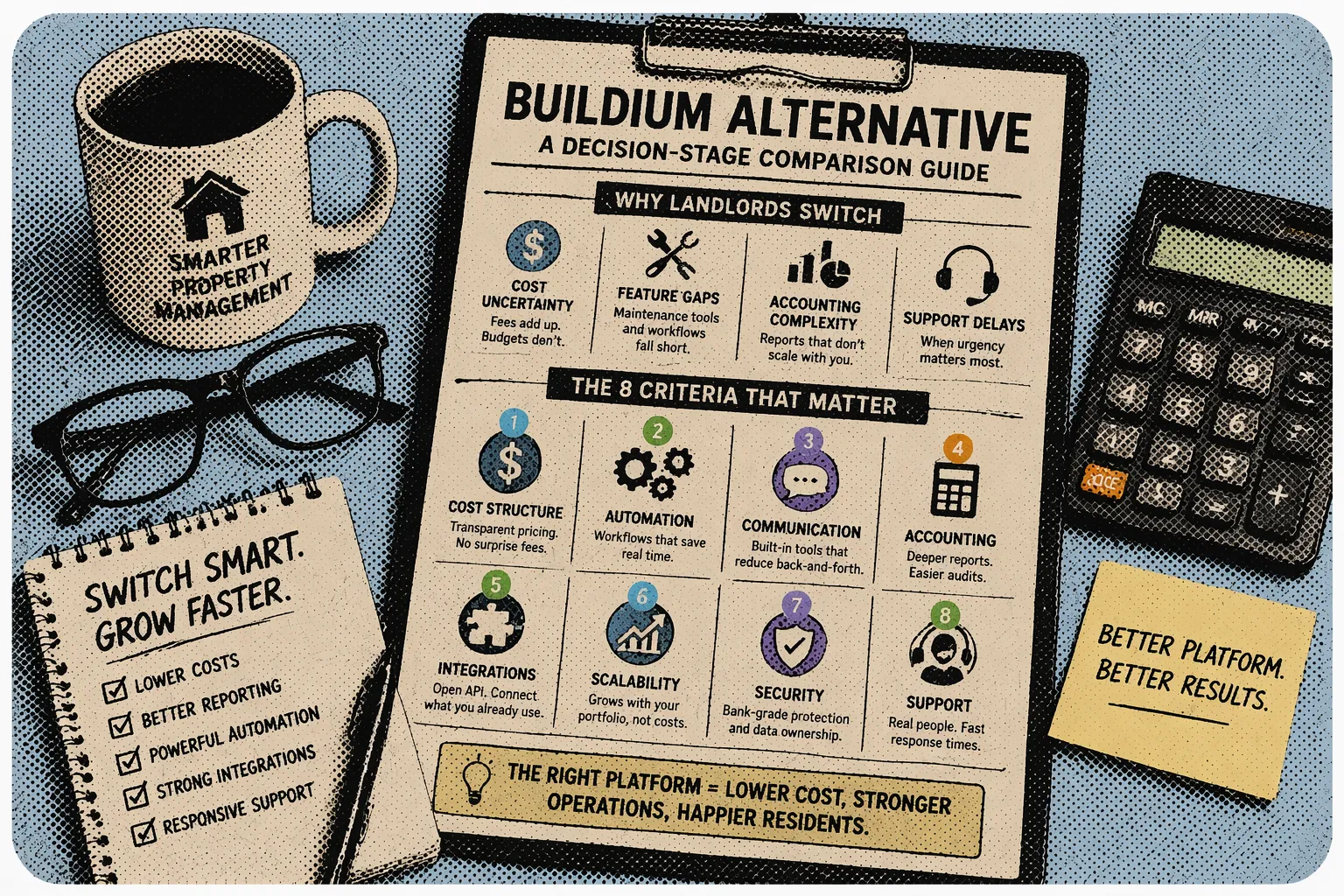
Buildium Alternative: A Decision-Stage Comparison Guide for Landlords and Property Managers
A Buildium alternative is a property management platform that addresses the specific friction points driving landlords and property managers away from Buildium: cost unpredictability, maintenance workflow limitations, accounting complexity at scale, and support responsiveness during time-sensitive situations. For independent landlords and small property managers overseeing 1 to 100 units, finding the right alternative is not about finding the most popular platform. It is about finding the one that matches your portfolio complexity, your support expectations, and your operational priorities before switching costs including data migration, retraining, and process rebuilding become the new problem.
Why Landlords Look for a Buildium Alternative
Buildium is widely used and established, with a customer base reported at more than 20,000 companies and over one million units across 46 countries. Review platforms show strong scores for ease of use and communication tools, and the platform covers the core workflows most landlords need: leasing, accounting, maintenance tracking, and resident and owner communication.
The decision to switch rarely shows up in star ratings. It shows up in monthly cost forecasts that keep changing, maintenance mobile limitations that create field workflow failures, accounting reporting that does not fit the way a growing portfolio needs to run, and support response times that feel acceptable in normal conditions but fall short during a weekend emergency.
Four patterns appear consistently among landlords actively evaluating alternatives:
Cost uncertainty. Property management platforms commonly run $1 to $5 per unit per month with minimum monthly fees and additional charges for onboarding, migration, payment processing, premium support, and add-on modules. When transaction fees stack on top of per-unit pricing, monthly costs become difficult to forecast and a growing unit count does not always mean a proportionally better deal.
Feature fit, not feature count. Users cite specific workflow gaps rather than a general lack of features. Maintenance mobile limitations and friction during technical issues are the most frequently mentioned. A platform with more features that executes your three critical workflows poorly is worse than one with fewer features that handles them reliably.
Accounting complexity. Some teams hit limitations as operations become more complex, particularly around multiple entities, advanced reporting, and owner statements at volume. The accounting capability that works well at 25 units may not meet the same operator's needs at 150.
Support responsiveness. Review feedback includes recurring mentions of slow support responses during incidents, even from users who otherwise praise the platform's professionalism. For property management, support quality during time-sensitive situations is a materially different standard than support quality for general questions.
How to Evaluate a Buildium Alternative: Eight Decision-Stage Criteria
1. Cost Structure and Total Cost of Ownership
Most buyers underestimate software cost because they compare only the advertised subscription. Build a 12-month total cost of ownership estimate that includes the subscription, likely add-ons, and transaction fees before comparing platforms.
What to ask vendors: What is the minimum monthly fee and how does it change with unit count? Are payments included, and if not, what are the tenant payment fees and owner payout fees? Is onboarding required and what does migration cost? Are key workflows such as owner statements, inspections, and work orders included or available as add-ons?
For a landlord managing 18 units, a platform with a $150 minimum effectively costs $8.33 per unit, which may be acceptable if it saves meaningful time but expensive if you only need rent collection and basic maintenance logging. For a property manager at 220 units, a lower per-unit rate can still increase significantly if you pay separate fees for texting, e-signatures, bank transfers, or additional user seats.
2. Automation Matched to Your Repeatable Pain Points
Automation creates real return on investment through fewer late-rent follow-ups, fewer manual ledger entries, and fewer missed communication moments. The question is not whether a platform has automation. It is whether the specific automations it offers address the tasks you repeat most often.
Test two scenarios during demos. For late rent, confirm that the platform supports rule-based sequences from reminder through late fee through notice template through payment plan option, and verify that partial payments do not break the workflow. For turnovers, confirm that a tenant's notice automatically triggers a checklist covering move-out inspection, vendor dispatch, marketing listing, screening pipeline, lease generation, and utility coordination.
A useful demo test: can you set a recurring charge and auto-late fee rules without hunting through menus? When a tenant partially pays or disputes a charge, how does the system reconcile without requiring manual ledger correction?
3. Tenant Communication as a Service Function
Communication in property management is not just sending messages. It is controlling volume, documenting compliance, and reducing back-and-forth in ways that protect you if a dispute escalates. Evaluate whether the platform's communication tools function as a documentation system, not just a messaging tool.
What to compare: Does the tenant portal support two-way messaging tied to a unit and lease record? Can tenants upload photos and video for maintenance requests? Are notices templated and stored rather than only emailed? Can you separate urgent after-hours issues from routine questions? A communication feature is only valuable if it reduces response time and improves documentation simultaneously.
4. Maintenance Workflows Built for Field Execution
Maintenance is where resident satisfaction, vendor costs, and vacancy risk converge. For any platform you evaluate, run one maintenance ticket end-to-end during the trial: photos, vendor assignment, approval, invoice entry, and owner chargeback. If it is clunky in a demo, it will be worse during a weekend emergency.
Two specific maintenance features that meaningfully reduce operational overhead: approval workflows that automatically route anything above a defined cost threshold to the owner portal for approval, and repeat issue tracking that surfaces a pattern of tickets on the same unit or system so you can make a replacement decision rather than continuing to pay for the same repair.
For field technicians, the mobile tool must function reliably with poor connectivity. If the app cannot cache tasks, capture photos offline, or quickly update status without a strong signal, your office will spend the next day reconciling what happened in the field.
5. Accounting Fit for Your Portfolio Complexity
There is a meaningful difference between landlord bookkeeping and property management accounting. Before evaluating accounting features, determine which category your operation falls into.
Simple landlord bookkeeping needs clean income and expense reporting for taxes, rent receipts, and straightforward bank reconciliation. Property management accounting at scale needs trust accounting concepts where applicable, separate bank accounts, management fees, owner distributions, and audit-friendly controls across multiple owners and entities.
Do not accept a general claim that a platform has accounting. Ask to see the exact reports you rely on using sample data: owner statements in your preferred format, delinquency reporting, profit and loss by property, and bank reconciliation workflows. If the platform cannot demonstrate those specific outputs, accounting limitations are likely to surface after you have already migrated.
6. Usability and the True Cost of Onboarding
Usability is where switching feels hardest because familiarity with a current platform creates an overestimation of switching cost and an underestimation of the cost of staying.
A practical usability test: give a teammate a checklist covering adding a unit, creating a lease, taking a payment, opening a maintenance ticket, and running a delinquency report. Time it, track how many times they ask for help, and repeat the test on two platforms during trials. If your operations depend on one power user who understands the current software, you do not have software infrastructure. You have a single point of failure.
Support quality is part of usability. Ask specifically about support channels, typical response times for billing questions versus accounting questions versus technical issues, and how the platform communicates known outages or system issues.
7. Integrations and Data Control
Define your non-negotiable tools before evaluating integrations. A Buildium alternative that forces you to rebuild your entire technology stack may cost more in time than it saves in subscription fees.
Integration questions that prevent headaches: Is there an API and is it available on your plan tier? Can you export all critical data in standard formats for use outside the platform? Are integrations two-way syncs or one-time data pushes? For each tool you currently use, confirm whether the alternative replaces it, integrates with it, or requires you to find a new solution.
If you want consolidation into one platform, verify that the consolidation is genuinely functional rather than nominal. A platform that technically covers accounting but requires significant manual workarounds provides less value than a clean integration with a tool you already trust.
8. Compliance and Risk Documentation
Software cannot replace legal advice, but it can reduce compliance risk by enforcing consistent process. The documentation that protects you in a fair housing inquiry, a security deposit dispute, or a lease enforcement situation is exactly the documentation that an operationally sound platform creates automatically as a byproduct of normal workflows.
What to look for: templates for notices and lease addenda that are customizable to your jurisdiction, document storage tied to the lease record rather than stored separately, role-based permissions controlling who can edit ledgers, waive fees, or change banking information, and audit logs for key actions including payment edits and fee reversals.
If a platform cannot show an audit trail for sensitive actions, it is not simpler. It is riskier.
Buildium Alternative Evaluation Scorecard
Use this to compare any platform you are evaluating. Score each item 0 to 2: 0 means no, 1 means partial, 2 means yes. Add notes and screenshots from demos.
Cost and total cost of ownership: Pricing model is clear with stated minimums. Payment processing fees are disclosed upfront for both tenant and owner payout. Onboarding and migration fees are optional or clearly scoped. Add-ons required for basic workflows are minimal.
Core operations: Rent collection, autopay, and late fee rules work correctly for partial payments. Lease lifecycle covers application through screening through e-signature through renewal through move-out. Tenant portal supports two-way messaging with file and photo upload. Maintenance covers ticketing, vendor assignment, approvals, and status tracking.
Accounting and reporting: Owner statements match your preferred format. Bank reconciliation is straightforward. Delinquency reporting is accurate and easy to run. Export for your CPA in clean CSV or PDF format is available.
Usability and support: A new user can complete five basic tasks in under 30 minutes. Help center and training resources exist. Support channels fit your needs and response time expectations. Known issues and uptime communication are transparent.
Integrations and data control: Integrates with your must-have tools or replaces them effectively. Data export includes leases, ledgers, contacts, and documents. API availability and two-way sync are present where relevant.
Compliance and risk: Notice templates and document storage are tied to the lease record. Role-based access and audit trails exist for sensitive actions. Deposit and inspection documentation supports dispute resolution.
Frequently Asked Questions
When does it make sense to switch from Buildium to an alternative?
Switching makes sense when the pain is structural rather than temporary: cost unpredictability that makes monthly forecasting difficult, accounting and reporting limitations that do not fit your portfolio complexity, or maintenance workflow friction that affects response times and vendor accountability. If a specific operational problem is consuming hours each week and a platform change would eliminate it, the switching cost is likely worth calculating.
What pricing should I expect from a Buildium alternative in 2026?
Most property management platforms run $1 to $5 per unit per month with minimum monthly fees commonly ranging from $50 to $300, plus potential onboarding and transaction fees. A landlord managing 25 units may effectively pay the monthly minimum, while a manager at 250 units may benefit from a lower per-unit tier but pay more in add-on fees. Build a 12-month total cost of ownership estimate before comparing headline prices.
What are the most overlooked costs when switching property management platforms?
The biggest hidden costs are time and operational disruption rather than platform fees. Data cleanup, migration mapping across leases, ledgers, and contacts, staff retraining, and rebuilding templates in the new system all represent real costs that do not appear in a subscription comparison. If historical ledgers are not migrated cleanly, year-end reporting becomes a manual reconstruction project regardless of how capable the new platform is.
How do I evaluate support quality before committing to a new platform?
Submit two to three support questions during your trial covering different categories: one billing question, one accounting question, and one maintenance workflow question. Measure response time and the quality of the answer. Ask specifically how the platform handles partial payments and late fees, and evaluate whether the response provides actionable steps or general marketing language. Support quality during normal operations and support quality during time-sensitive incidents are meaningfully different standards to test for.
Ready to see how Shuk compares on the criteria that matter most to your portfolio? Book a demo and walk through rent collection, maintenance workflows, owner reporting, and renewal tools with your specific unit count and operating model in mind.
Frequently Asked Questions
Find answers to common questions about our products and services
What criteria matter most when comparing property management software alternatives in 2026?
What should I test during a property management software trial in 2026?
How long does a property management software migration typically take?
How do I calculate true total cost of ownership for a property management platform?
When does it make sense to switch property management software?
The software decision that matters most is the one made before you are locked into a contract: confirming that the platform handles the three or four workflows you run every day without friction, that the total cost is predictable as your unit count grows, and that support is available when something goes wrong at the worst possible time. Platforms like Shuk Rentals are built specifically for independent landlords and small property managers managing 1 to 100 units, with rent collection, maintenance tracking, lease management, tenant communication, and renewal tools in one connected system at a predictable per-unit price.