Tenant Screening Hub

Income Verification for Rental Applications: Best Practices for Landlords

photo of Miles Lerner, Blog Post Author
Miles Lerner

Income Verification Best Practices

Income verification for rental applications is the process of confirming that an applicant earns enough to pay the rent reliably, that the income claimed is genuine and stable, and that the documentation provided accurately represents actual earnings. For independent landlords, income verification is both the most critical screening step for predicting long-term payment behavior and the step most commonly weakened by accepting a single document at face value. Application fraud involving edited pay stubs, falsified employment letters, and manipulated bank statements has become significantly more common, making a multi-source verification approach the functional standard rather than a precaution reserved for suspicious applications.

What Good Income Verification Accomplishes

Effective income verification answers three questions: Is the income real? Is the income stable? And is the income sufficient against the written standard applied to every applicant?

Answering all three requires more than reviewing a single pay stub. It requires a document package that can be cross-validated, an employment or income source confirmation through an independently obtained contact, and a calculation that applies the stated standard consistently regardless of employment type.

Step-by-Step Income Verification Workflow

Step 1. Define the Income Standard in Writing Before Taking Applications

The income standard must be established before any specific applicant's information is reviewed. The most common benchmark is gross monthly income of at least three times the monthly rent. Your specific standard may differ but must be documented and applied equally to every applicant.

The written standard should also specify how you treat different income types, what documentation is required for W-2 employment versus self-employment versus benefits, and what compensating factors allow approval despite income that falls below the standard. Apply the standard to the tenant-paid portion of rent for applicants using housing vouchers rather than the full contract rent. Many jurisdictions protect source of income as a class, and applying the income ratio inconsistently between voucher holders and other applicants creates discriminatory exposure.

Step 2. Collect a Document Package That Enables Cross-Validation

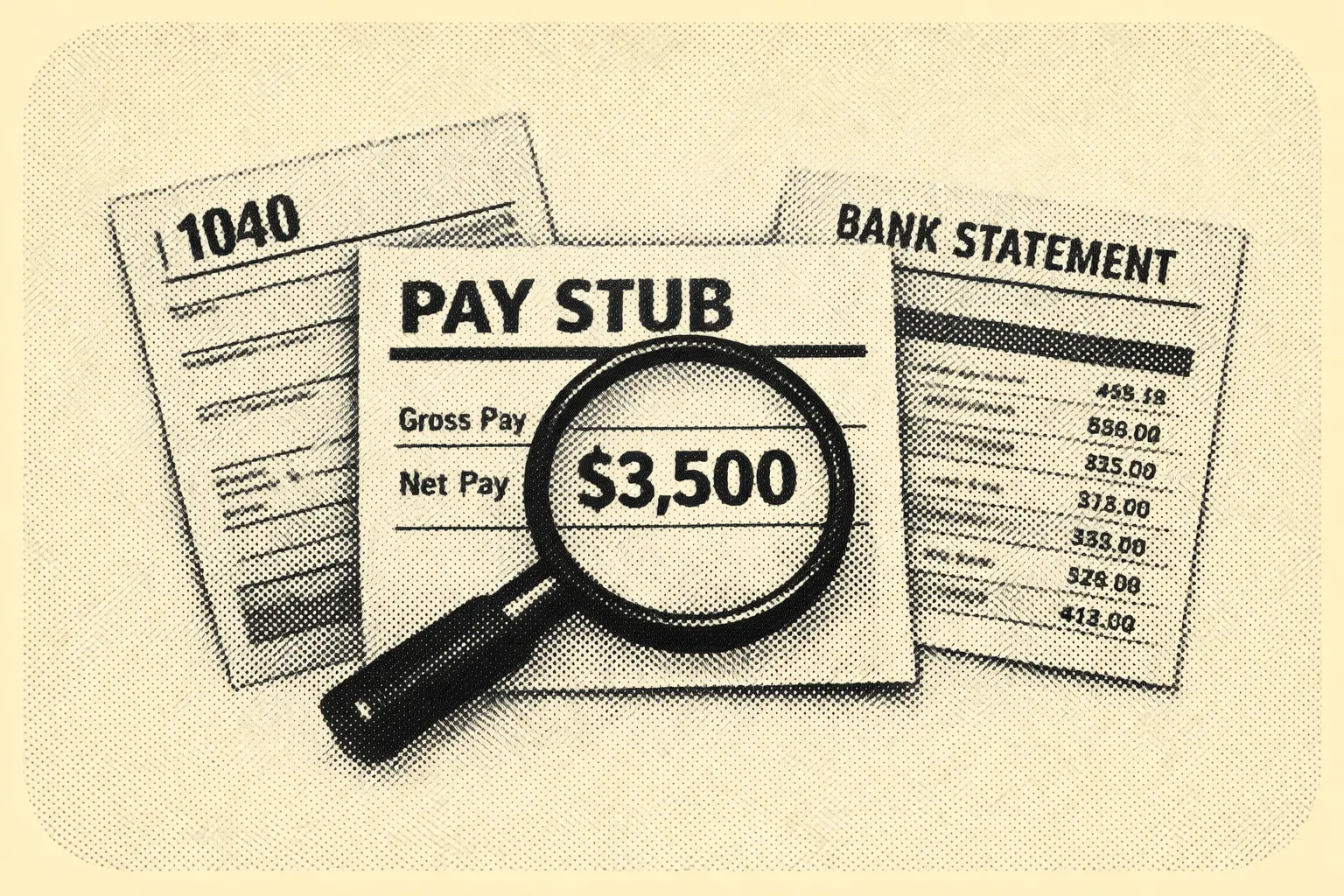
For W-2 employees, the standard package is two to three consecutive recent pay stubs and two months of bank statements showing payroll deposits at the corresponding frequency and net pay amount. An offer letter confirming the employment status and compensation rate is useful as a third source.

For self-employed applicants, the most reliable combination is the prior year tax return with all schedules and three months of business and personal bank statements showing consistent deposits.

For fixed-income applicants receiving Social Security, pension payments, or disability benefits, a benefit award letter downloaded directly from the agency's online portal combined with bank statements showing matching deposits provides reliable verification.

Step 3. Calculate the Rent-to-Income Ratio Using a Consistent Method

Apply the income standard using the same calculation method for every applicant. For employees with variable income components, use a conservative average of the trailing three to six months rather than a peak period. Document the specific income figure used, how it was calculated, and the resulting rent-to-income ratio.

Step 4. Verify Employment and Income Source Through an Independently Obtained Contact

For W-2 employees, verify employment through the main phone number of the employer obtained from a publicly listed source such as the company website rather than from the employment letter or pay stub. Confirm that the applicant is an active employee in the stated role. Log every verification attempt: the date, who was contacted, how, and what was confirmed.

For self-employed applicants, verify through a third source such as a business registration confirmation, client letters, or relevant licensing.

Step 5. Identify and Evaluate Document Red Flags

Pay stubs with identical net pay in every period despite variable hours are a common fraud signal. A calculation of whether the YTD earnings figure is mathematically consistent with the period earnings is one of the fastest fraud detection checks available. Bank statements with formatting inconsistencies across pages or deposit entries that do not correspond to the pay frequency described in the pay stubs warrant a pause and a request for clarification.

Step 6. Document the Decision and Apply the Standard Consistently

Complete the verification with a written record showing the income figure verified, the method of verification, the rent-to-income ratio calculated, whether the standard was met, any compensating factors applied, and the resulting decision. This record should be the same format for every applicant. If a consumer report contributed to the decision, FCRA adverse action requirements apply.

Income Verification Checklist

Pre-screen criteria: Written income standard documented. Income types accepted defined. Variable income averaging method defined. Treatment of voucher and subsidy income documented.

Document collection (W-2 employment): Two to three consecutive pay stubs. Two months of bank statements showing payroll deposits. Offer letter or employment confirmation.

Document collection (self-employed): Prior year tax return with all schedules. Three months of bank and business statements.

Document collection (fixed income): Benefit award letter from agency source. Bank statements showing matching deposits.

Calculation: Verified gross monthly income documented. Variable income calculated using defined averaging method. Rent-to-income ratio calculated and compared to written standard. Result documented in file.

Employment verification: Employer contacted through independently obtained contact. Confirmation documented with date, method, and outcome.

Document authenticity review: YTD figures mathematically checked. Pay frequency consistent with bank deposit pattern. Any anomaly documented and followed up.

Decision: Income standard met or not met documented. Compensating factor applied or not applied documented. File retained per retention policy.

Frequently Asked Questions

What is the standard rent-to-income ratio for rental applications?

The most commonly applied benchmark is gross monthly income of at least three times the monthly rent, corresponding to housing costs of approximately 30% of gross income. Your specific standard may vary but must be documented and applied equally to every applicant. For applicants using housing vouchers, apply the ratio to the tenant-paid portion of rent rather than the full contract rent to avoid source-of-income discrimination in jurisdictions that protect it.

What proof of income should a landlord accept for rental applications?

Acceptable proof depends on employment type. W-2 employees should provide consecutive pay stubs and bank statements showing corresponding deposits. Self-employed applicants should provide tax returns with all schedules and bank statements. Fixed-income applicants should provide benefit award letters and bank statements. Requiring the same documents for the same income type applied equally to every applicant satisfies both the verification goal and the fair housing consistency requirement.

How do landlords verify income for self-employed applicants?

Self-employed income verification relies on the prior year tax return with all schedules for an annual baseline and three months of bank statements showing recent cash flow. A conservative approach averages trailing six to twelve months of deposits rather than using a peak period. When additional confidence is needed, an IRS Form 4506-C authorizing transcript access can corroborate reported tax figures through official records.

What are the biggest income verification red flags to watch for?

The most reliable fraud indicators are YTD figures mathematically inconsistent with period earnings, identical net pay figures in every period despite variable hours, pay frequency that does not match bank deposit patterns, missing standard fields such as employer address or pay period identifiers, and bank statement formatting inconsistencies. Require consecutive documents and verify the basic arithmetic before treating any document as confirmed.

Can a landlord deny an applicant solely because of income?

Yes, if the denial is based on a consistently applied, written income standard supported by a documented calculation. The risk arises when the standard is applied selectively, when different documentation requirements are imposed on different applicants for the same income type, or when the income standard functions as discrimination based on source of income in jurisdictions that protect it.

Book a demo to see how Shuk helps landlords stay ahead of vacancies and keep units filled.

QUICK VIEW
DIVE DEEPER
Stop Reacting to Vacancies. Start Seeing Them Coming.

Shuk helps landlords and property managers get ahead of vacancies, improve renewal visibility, and bring more predictability to every lease cycle.

Book a free 20-min demo to see Shuk today.

Stay in the Shuk Loop

Income Verification Best Practices

Income verification for rental applications is the process of confirming that an applicant earns enough to pay the rent reliably, that the income claimed is genuine and stable, and that the documentation provided accurately represents actual earnings. For independent landlords, income verification is both the most critical screening step for predicting long-term payment behavior and the step most commonly weakened by accepting a single document at face value. Application fraud involving edited pay stubs, falsified employment letters, and manipulated bank statements has become significantly more common, making a multi-source verification approach the functional standard rather than a precaution reserved for suspicious applications.

What Good Income Verification Accomplishes

Effective income verification answers three questions: Is the income real? Is the income stable? And is the income sufficient against the written standard applied to every applicant?

Answering all three requires more than reviewing a single pay stub. It requires a document package that can be cross-validated, an employment or income source confirmation through an independently obtained contact, and a calculation that applies the stated standard consistently regardless of employment type.

Step-by-Step Income Verification Workflow

Step 1. Define the Income Standard in Writing Before Taking Applications

The income standard must be established before any specific applicant's information is reviewed. The most common benchmark is gross monthly income of at least three times the monthly rent. Your specific standard may differ but must be documented and applied equally to every applicant.

The written standard should also specify how you treat different income types, what documentation is required for W-2 employment versus self-employment versus benefits, and what compensating factors allow approval despite income that falls below the standard. Apply the standard to the tenant-paid portion of rent for applicants using housing vouchers rather than the full contract rent. Many jurisdictions protect source of income as a class, and applying the income ratio inconsistently between voucher holders and other applicants creates discriminatory exposure.

Step 2. Collect a Document Package That Enables Cross-Validation

For W-2 employees, the standard package is two to three consecutive recent pay stubs and two months of bank statements showing payroll deposits at the corresponding frequency and net pay amount. An offer letter confirming the employment status and compensation rate is useful as a third source.

For self-employed applicants, the most reliable combination is the prior year tax return with all schedules and three months of business and personal bank statements showing consistent deposits.

For fixed-income applicants receiving Social Security, pension payments, or disability benefits, a benefit award letter downloaded directly from the agency's online portal combined with bank statements showing matching deposits provides reliable verification.

Step 3. Calculate the Rent-to-Income Ratio Using a Consistent Method

Apply the income standard using the same calculation method for every applicant. For employees with variable income components, use a conservative average of the trailing three to six months rather than a peak period. Document the specific income figure used, how it was calculated, and the resulting rent-to-income ratio.

Step 4. Verify Employment and Income Source Through an Independently Obtained Contact

For W-2 employees, verify employment through the main phone number of the employer obtained from a publicly listed source such as the company website rather than from the employment letter or pay stub. Confirm that the applicant is an active employee in the stated role. Log every verification attempt: the date, who was contacted, how, and what was confirmed.

For self-employed applicants, verify through a third source such as a business registration confirmation, client letters, or relevant licensing.

Step 5. Identify and Evaluate Document Red Flags

Pay stubs with identical net pay in every period despite variable hours are a common fraud signal. A calculation of whether the YTD earnings figure is mathematically consistent with the period earnings is one of the fastest fraud detection checks available. Bank statements with formatting inconsistencies across pages or deposit entries that do not correspond to the pay frequency described in the pay stubs warrant a pause and a request for clarification.

Step 6. Document the Decision and Apply the Standard Consistently

Complete the verification with a written record showing the income figure verified, the method of verification, the rent-to-income ratio calculated, whether the standard was met, any compensating factors applied, and the resulting decision. This record should be the same format for every applicant. If a consumer report contributed to the decision, FCRA adverse action requirements apply.

Income Verification Checklist

Pre-screen criteria: Written income standard documented. Income types accepted defined. Variable income averaging method defined. Treatment of voucher and subsidy income documented.

Document collection (W-2 employment): Two to three consecutive pay stubs. Two months of bank statements showing payroll deposits. Offer letter or employment confirmation.

Document collection (self-employed): Prior year tax return with all schedules. Three months of bank and business statements.

Document collection (fixed income): Benefit award letter from agency source. Bank statements showing matching deposits.

Calculation: Verified gross monthly income documented. Variable income calculated using defined averaging method. Rent-to-income ratio calculated and compared to written standard. Result documented in file.

Employment verification: Employer contacted through independently obtained contact. Confirmation documented with date, method, and outcome.

Document authenticity review: YTD figures mathematically checked. Pay frequency consistent with bank deposit pattern. Any anomaly documented and followed up.

Decision: Income standard met or not met documented. Compensating factor applied or not applied documented. File retained per retention policy.

Frequently Asked Questions

What is the standard rent-to-income ratio for rental applications?

The most commonly applied benchmark is gross monthly income of at least three times the monthly rent, corresponding to housing costs of approximately 30% of gross income. Your specific standard may vary but must be documented and applied equally to every applicant. For applicants using housing vouchers, apply the ratio to the tenant-paid portion of rent rather than the full contract rent to avoid source-of-income discrimination in jurisdictions that protect it.

What proof of income should a landlord accept for rental applications?

Acceptable proof depends on employment type. W-2 employees should provide consecutive pay stubs and bank statements showing corresponding deposits. Self-employed applicants should provide tax returns with all schedules and bank statements. Fixed-income applicants should provide benefit award letters and bank statements. Requiring the same documents for the same income type applied equally to every applicant satisfies both the verification goal and the fair housing consistency requirement.

How do landlords verify income for self-employed applicants?

Self-employed income verification relies on the prior year tax return with all schedules for an annual baseline and three months of bank statements showing recent cash flow. A conservative approach averages trailing six to twelve months of deposits rather than using a peak period. When additional confidence is needed, an IRS Form 4506-C authorizing transcript access can corroborate reported tax figures through official records.

What are the biggest income verification red flags to watch for?

The most reliable fraud indicators are YTD figures mathematically inconsistent with period earnings, identical net pay figures in every period despite variable hours, pay frequency that does not match bank deposit patterns, missing standard fields such as employer address or pay period identifiers, and bank statement formatting inconsistencies. Require consecutive documents and verify the basic arithmetic before treating any document as confirmed.

Can a landlord deny an applicant solely because of income?

Yes, if the denial is based on a consistently applied, written income standard supported by a documented calculation. The risk arises when the standard is applied selectively, when different documentation requirements are imposed on different applicants for the same income type, or when the income standard functions as discrimination based on source of income in jurisdictions that protect it.

Book a demo to see how Shuk helps landlords stay ahead of vacancies and keep units filled.

{

  "@context": "https://schema.org",

  "@type": "FAQPage",

  "mainEntity": [

    {

      "@type": "Question",

      "name": "What is the standard rent-to-income ratio for rental applications?",

      "acceptedAnswer": {

        "@type": "Answer",

        "text": "The most commonly applied benchmark is gross monthly income of at least three times the monthly rent, corresponding to housing costs of approximately 30% of gross income. Your specific standard must be documented and applied equally to every applicant. For applicants using housing vouchers, apply the ratio to the tenant-paid portion of rent to avoid source-of-income discrimination in jurisdictions that protect it."

      }

    },

    {

      "@type": "Question",

      "name": "What proof of income should a landlord accept for rental applications?",

      "acceptedAnswer": {

        "@type": "Answer",

        "text": "Acceptable proof depends on employment type. W-2 employees should provide consecutive pay stubs and bank statements. Self-employed applicants should provide tax returns with all schedules and bank statements. Fixed-income applicants should provide benefit award letters and bank statements. Requiring the same documents for the same income type applied equally to every applicant satisfies both the verification goal and the fair housing consistency requirement."

      }

    },

    {

      "@type": "Question",

      "name": "How do landlords verify income for self-employed applicants?",

      "acceptedAnswer": {

        "@type": "Answer",

        "text": "Self-employed income verification relies on the prior year tax return for an annual baseline and three months of bank statements showing recent cash flow. A conservative approach averages trailing six to twelve months of deposits. When additional confidence is needed, an IRS Form 4506-C authorizing transcript access can corroborate reported tax figures through official records."

      }

    },

    {

      "@type": "Question",

      "name": "What are the biggest income verification red flags to watch for?",

      "acceptedAnswer": {

        "@type": "Answer",

        "text": "The most reliable fraud indicators are YTD figures mathematically inconsistent with period earnings, identical net pay in every period despite variable hours, pay frequency not matching bank deposit patterns, missing standard payroll fields, and bank statement formatting inconsistencies. Require consecutive documents and verify the basic arithmetic before treating any document as confirmed."

      }

    },

    {

      "@type": "Question",

      "name": "Can a landlord deny an applicant solely because of income?",

      "acceptedAnswer": {

        "@type": "Answer",

        "text": "Yes, if the denial is based on a consistently applied, written income standard supported by a documented calculation. The risk arises when the standard is applied selectively, when different documentation requirements are imposed on different applicants for the same income type, or when the income standard functions as source-of-income discrimination in jurisdictions that protect it."

      }

    }

  ]

}

Stop Reacting to Vacancies. Start Seeing Them Coming.

Shuk helps landlords and property managers get ahead of vacancies, improve renewal visibility, and bring more predictability to every lease cycle.

Book a demo to get started with a free trial.

Stay in the Shuk Loop

View Similar Articles

View Similar Articles

All Articles
Tenant Screening Hub
What Are Tenant Screening Services? A Practical Guide for Independent Landlords

What Are Tenant Screening Services? A Practical Guide for Independent Landlords

Why Screening Matters When One Wrong Lease Can Derail Your Cash Flow

If you own one to four rental units, one bad tenant decision can quickly become an all-hands crisis. Missed rent does not just cut into profit. It can threaten your mortgage payment, maintenance budget, and ability to keep the property in good shape.

National eviction data shows how common the problem is. In a typical year, roughly 3.6 million eviction cases are filed in the U.S., according to Eviction Lab. The true cost of an eviction often goes far beyond court filing fees. Industry estimates commonly place the average eviction cost around $3,500, and in tougher situations (extended vacancy, major damages, attorney time) that number can climb toward $10,000, per TransUnion's newsroom coverage.

Small landlords feel this especially hard. JPMorgan Chase Institute research on small property owners during and after COVID shows many experienced tenant non-payment and operational strain, pushing them toward more structured screening and rent collection practices. Small landlords are frequently "least able to absorb shocks," especially when they own only a handful of units.

That is where tenant screening services come in. Used correctly, they help you move from gut-feel decisions to consistent, documented, compliance-aware choices, often through a single online workflow that bundles a tenant background check, credit insights, and eviction-history data.

Example. If your rent is $1,400 and an eviction costs $3,500 to $10,000, avoiding just one bad outcome can cover years of screening fees.

Treat screening like insurance. A modest, repeatable process that protects cash flow and reduces surprise risk.

What Tenant Screening Services Are, and What You Will Actually Get

Tenant screening services are online tools that help landlords evaluate applicants using standardized reports and identity-verified data, typically combining a credit check, public-record background information, and rental-risk indicators like eviction history. Instead of you calling courthouses, chasing pay stubs, and piecing together partial records, screening services centralize the work into a few steps. Collect an application, obtain consent, run reports, and review results in a consistent way.

Here is what modern platforms often include

Credit-based risk information. Tradelines, collections, and risk scores built for rental behavior (not just general credit). TransUnion's tenant-focused scoring models, for example, are designed to predict eviction risk more directly than generic scores.

Eviction history databases. Some services provide access to large eviction datasets. TransUnion has described coverage exceeding 24 million eviction records.

Criminal background checks. Often state and county records, sometimes with national database components. Coverage varies by provider and jurisdiction.

Income and employment signals or verification add-ons. Certain tools estimate or validate income patterns using credit-file attributes and other data.

Just as important: reputable tenant screening services are designed to support compliance. They typically provide consent workflows and adverse action support to help you follow the Fair Credit Reporting Act (FCRA) when you use consumer reports to deny an application or require additional conditions. (This article provides general education, not legal advice. Before relying on any screening or adverse-action process, confirm your obligations with a qualified attorney.)

What you will learn next: a step-by-step process for rental application screening, how to read reports without overreacting, and how to stay consistent to reduce risk and reduce legal exposure.

Step-by-Step: How to Use Tenant Screening Services Effectively (and Legally)

Step 1: Set Rental Criteria Before You Collect Applications. Consistency Reduces Risk

Before you run a single tenant background check, define written screening criteria you will apply to every applicant for that unit. This is both a business best practice and a fairness safeguard. HUD emphasizes structured tenant selection practices (clear requirements, consistent processes, and documentation) so landlords can make defensible decisions.

Start simple

  • Minimum income-to-rent guideline (for example, 3x rent), acceptable documentation types
  • Credit standards (for example, no unpaid landlord collections, consider overall pattern, not just score)
  • Eviction history policy (for example, no filings in last X years, or evaluate context)
  • Criminal history policy (jurisdictions vary, avoid blanket bans, focus on relevance)

Pitfall to avoid. Changing standards mid-stream because one applicant "seems nice." Inconsistent criteria is where fair housing disputes and FCRA mistakes often start.

Example. If your property is in a $1,000 median-rent market (the HUD Rental Housing Finance Survey has reported a median monthly rent of $1,000), your income threshold and debt load expectations should reflect that local reality, not a generic online rule.

What to do next. Put your criteria in writing and keep it with the unit file. If you ever need to explain your decision, this is your anchor.

Step 2: Choose an Integrated Online Service (Credit Plus Eviction Plus Background) Instead of Piecemeal Reports

A standalone credit report can be helpful, but it is rarely enough by itself. Integrated tenant screening services bundle multiple risk signals (credit behavior, eviction history, and background checks) into one workflow. The benefit is not just convenience. It is fewer missed steps and more consistent decision-making.

Look for

  • Applicant identity verification steps (reduces fraud risk)
  • A tenant-friendly consent process (important for FCRA)
  • Clear report sections: credit, collections, eviction records, criminal records (where offered)
  • Transparent pricing and quick turnaround

Costs typically run $15 to $55 per applicant depending on package depth, with some comprehensive bundles priced in the $25 to $48 range for well-known credit-bureau-backed offerings.

Mini case study. A landlord with a duplex uses only a basic credit report. The applicant has a fair score but multiple prior landlord-related collections that do not stand out without a rental-focused view. Next year, the landlord switches to an integrated platform that highlights eviction and collection patterns. They start catching "rental debt" red flags earlier and reduce late payments.

What to do next. If you are new, pay for a package that includes eviction and collection indicators, not just a score. The small extra cost may be trivial compared with a $3,500-plus eviction outcome.

Step 3: Collect a Complete Application and Get Proper Written Authorization. FCRA Essentials

Under the FCRA, if you use a consumer report (credit, eviction, background data from a consumer reporting agency) to make a housing decision, you generally need the applicant's permission and must follow adverse action requirements if you deny or conditionally approve. The CFPB has published market-level information on tenant background checks and consumer reporting issues, highlighting the importance of accuracy, dispute rights, and proper processes.

Best practices for rental application screening

  • Use a consistent application form for all applicants
  • Obtain explicit authorization before ordering reports
  • Tell applicants what you will screen (credit, eviction, criminal where applicable)
  • Verify identity basics early (name, DOB, SSN or other lawful identifiers depending on your process)

Pitfall to avoid. Running reports before authorization or using "informal" background searches you cannot document.

Example. If two roommates apply, screen each adult occupant consistently. If you only screen the "best looking" applicant, you increase both risk and inconsistency.

What to do next. Save a PDF of the signed authorization and your criteria sheet in the applicant file. This is low effort and high protection.

Step 4: Read the Credit Section Like a Landlord. Focus on Patterns Tied to Rent Risk

A credit check for tenants is useful when you interpret it through a rental lens. A single late credit card payment two years ago is not the same as a pattern of unpaid obligations, recent collections, or heavy utilization that suggests financial instability.

Rental-focused scoring can be especially helpful for new landlords because it translates credit-file attributes into rental risk. TransUnion describes a resident-focused score range (for example, 350 to 850) and reports eviction-rate differences across score bands, such as very low eviction rates in higher bands vs. substantially higher rates in lower bands. Use scores as one input, not the only decision tool.

What to look at beyond the number

  • Collections. Especially housing-related or utility collections.
  • Recent delinquencies. Last 12 months matter more than older issues.
  • Debt load vs. stated income. Does it fit the rent?
  • Signs of instability. Frequent address changes may warrant questions. Confirm via application and references.

Mini case study. You have two applicants for a $1,600 unit. Applicant A has a higher score but recent collections and thin savings. Applicant B has a modest score but clean recent history and stable employment. A rental-focused review may favor B if the pattern suggests steadier payment behavior.

What to do next. Create a "credit notes" habit. Write 3 bullets per applicant (strengths, concerns, clarifying questions). It keeps you consistent.

Step 5: Use Eviction History and Collections as a Major Risk Signal, but Verify and Apply Fairly

Eviction filings are common enough that landlords should understand them. Eviction Lab estimates millions of filings annually. Some screening products offer large eviction-record coverage. TransUnion has stated access to more than 24 million eviction records. TransUnion has also reported that residents with eviction records show much higher incidence of collection records than non-evicted residents, a signal of broader payment distress.

But eviction data requires caution:

  • Records may include filings that did not result in removal or were dismissed
  • Some jurisdictions have sealing rules or limited access (laws are changing, check your state and local rules)
  • Overreliance can create disparate impacts, which is why transparency and consistency matter

Example. An applicant has one eviction filing from five years ago that was dismissed after the landlord accepted payment. If your written policy is "no filings in last 3 years," that applicant may still qualify, if documentation supports it.

What to do next. If something looks like a mismatch, ask a clarifying question and allow the applicant to explain. Document the answer and keep it tied to your pre-set criteria.

Step 6: Handle Criminal Background Information Carefully. Avoid Blanket Rules, Focus on Relevance

Many tenant screening services include criminal record searches. If you use them, be careful. A blanket "any record = denial" policy can raise fair housing concerns and may conflict with local rules or guidance trends. HUD and fair housing best practices generally favor individualized assessment, considering the nature, severity, and recency of relevant conduct.

Practical, beginner-friendly approach

  • Define what matters for your property (for example, violence or property damage risk)
  • Consider time since conviction and evidence of rehabilitation
  • Apply the same policy to every applicant for that unit

Pitfall to avoid. Informal internet searches that turn up arrests, mugshots, or inaccurate information you cannot verify. Use the formal report you ordered with consent, and give applicants a chance to dispute inaccuracies under FCRA processes.

What to do next. If you do deny based on a report from a consumer reporting agency, follow FCRA adverse action steps (notice, report info, dispute rights). Do not ghost the applicant.

Step 7: Make the Decision, Communicate It Properly, and Keep a Clean Paper Trail

Once you have reviewed the full file (application, income documentation, credit and eviction and background reports, and references), decide using your written criteria. If you approve with conditions (higher deposit where legal, cosigner, shorter lease, or automatic payments), ensure those conditions are allowed in your jurisdiction and applied consistently.

Why documentation matters

  • It reduces "he said, she said" confusion
  • It helps you show consistent treatment if questioned
  • It supports FCRA compliance if you took adverse action based on a report

Mini case study. A landlord denies an applicant after seeing a high-risk report but fails to send an adverse action notice. The applicant requests the basis for denial and disputes the data. A simple, compliant notice and documented criteria would have reduced conflict and time.

What to do next. Save these four items for every applicant. (1) Criteria, (2) authorization, (3) reports, (4) decision notes and any notices sent.

Checklist: A Tenant Screening Workflow (Small Landlord Edition)

Use this checklist to standardize your process across units and applicants. Consistency is your best friend. It saves time, reduces emotional decision-making, and helps you stay aligned with fair housing principles and FCRA obligations when using consumer reports.

A) Before marketing the unit

  • Write screening criteria (income, credit patterns, eviction policy, occupancy rules)
  • Confirm application fee rules in your state and city (some areas cap fees, verify locally)
  • Prepare required disclosures and authorization language (FCRA-consistent)

B) When applications arrive

  • Use the same application for every adult applicant
  • Collect ID and income documentation standards (same for everyone)
  • Get signed authorization before ordering reports

C) Order reports via tenant screening services

  • Credit report and resident-focused score (if available)
  • Eviction history search
  • Criminal background (if used, apply individualized standards)
  • Income insights or verification (optional)

D) Review and decision

  • Compare each result to your written criteria (not to other applicants)
  • Ask clarifying questions and document answers
  • Approve, conditionally approve, or deny

E) Compliance and recordkeeping

  • If denying or adding conditions based on a report, send FCRA adverse action notice and include required information
  • Save all documents in the unit file for a reasonable retention period (check local guidance)

FAQ

How much do tenant screening services cost, and who pays?

Many screening packages land in the $15 to $55 per applicant range, depending on how much is included (credit, eviction, criminal, income tools). Some services price comprehensive bundles around $25 to $48 for credit-bureau-backed offerings. Who pays varies by state and local rules. Some landlords pass the cost to applicants via an application or screening fee, while others pay to encourage more applicants. If you charge a fee, confirm your local rules and fee caps. The cost of screening is minor relative to the $3,500 to $10,000 cost of a single eviction.

How fast do tenant screening reports come back?

Many online screenings return quickly, sometimes within minutes for credit components, while certain background or court record searches can take longer depending on county record systems. The practical tip: plan your showing-to-decision timeline so you are not pressured into skipping steps. If you need a decision in 24 hours, choose a service with an integrated workflow and clear turnaround expectations.

What if an applicant has no credit history or is new to the U.S.?

A thin or absent credit file does not automatically mean "high risk." Consider alternative documentation: larger verified savings, stable job offer letters, verified income, or a qualified guarantor (where legal). Some tools also incorporate income insights and rental-focused signals that may help you evaluate applicants beyond a traditional score. The key is to define acceptable alternatives in your written criteria before you review applications, so you apply them consistently to everyone.

Is it legal to deny someone based on criminal history or an eviction record?

It can be legal in some cases, but it is sensitive and heavily shaped by state and local rules. Best practice is to avoid blanket exclusions and instead use consistent, property-related criteria with individualized consideration. If you rely on a consumer report for denial, follow FCRA adverse action requirements and allow applicants to dispute inaccuracies. Criminal and eviction history policies are an area where consulting a qualified attorney before setting your criteria is worth the investment, because getting it wrong can create liability that far exceeds the cost of legal review.

What to Do Next: Start Small, Stay Consistent, Use an Integrated Tool

If you are new to screening, your best next step is to choose a simple, integrated online process and run it the same way every time. Build your written criteria, collect authorization, then use tenant screening services that combine a tenant background check, eviction history, and a credit check in one place.

This is where Shuk fits into the screening workflow. Shuk provides tenant screening through our partner (RentPrep/TransUnion), so you get credit, criminal, and eviction reports as part of your screening process without shopping for a separate screening vendor or assembling piecemeal reports from multiple providers.

Around the screening report, Shuk's centralized in-app messaging with email and push notifications gives you a time-stamped record of every applicant conversation, authorization exchange, and verification follow-up. Document storage keeps the application, ID, income documentation, landlord-reference notes, screening report, and your decision documentation organized in one place per applicant. And when you make a placement, the same Shuk subscription gives you e-signature for the lease through our Adobe-powered integration, so the transition from approved applicant to signed tenant happens in one connected system.

After the lease is signed, Shuk gives you the rest of the rental operating stack. Online rent collection with zero ACH transaction fees and configurable late fees applied automatically. Maintenance request tracking with photos, documents, and a complete history per property. Schedule E-aligned expense organization with digital receipts. The Lease Indication Tool for predictive lease renewal insights through monthly tenant polling starting six months before lease end. Two-Way Reviews between landlords and tenants that build verifiable rental reputations (which means your next screening decision can start from a verified rental track record, not just a credit report). And Year-Round Marketing.

At as low as $2.00 per unit per month with no setup fees, and with White Glove Onboarding included at no additional cost (where the Shuk team handles property setup, account preparation, and renter onboarding for you), Shuk makes structured, documented screening and the entire rental workflow feasible for landlords and property managers running 1 to 100 units. Shuk now supports third-party management with multi-user workflows and role-based access, so a property management team can run consistent screening standards across an entire portfolio.

Book a demo at shukrentals.com/book-a-demo to see how Shuk's tenant screening through our partner, centralized in-app messaging, document storage, e-signature, online rent collection with zero ACH fees, automated late fees, maintenance request tracking, Schedule E-aligned expense organization, the Lease Indication Tool, Two-Way Reviews, and Year-Round Marketing work together so screening becomes a repeatable system built into your rental workflow.


Property Acquisition Hub
Wraps and Due-on-Sale Risk: What Investors Need to Know Before Closing

Wraps and Due-on-Sale Risk

The Core Problem: Attractive Spreads Meet Contract Reality

A wraparound mortgage can look like a clean path to acquiring property with an existing low-rate loan. You pay the seller on a new note, the seller keeps paying the original lender, and in a high-rate environment that spread can turn a marginal deal into a strong one. No new bank loan, no appraisal delays, no DSCR hoops.

Here is the friction: the due-on-sale clause on the underlying mortgage. Most mortgages allow the lender to accelerate (call the loan due in full) when property is sold or transferred without consent. Federal law largely favors enforceability, with narrow, specific exceptions. The practical risk is not theoretical. Servicing guides for the biggest mortgage investors explicitly instruct servicers to enforce due-on-sale provisions after an unapproved transfer in many circumstances, per Fannie Mae and Freddie Mac servicing guidance.

If you are evaluating a wrap, your real question is not "Is a wrap legal?" It is: "Can I execute and operate this wrap in a way that keeps the underlying lender paid, minimizes detection triggers, and gives me a defensible mitigation plan if a call happens?"

Note: This article provides general education about wraparound mortgages and due-on-sale clauses, not legal advice. Federal preemption rules, statutory exceptions, servicing enforcement practices, and state-specific foreclosure procedures vary significantly. Before structuring or closing any wrap transaction, consult a qualified real estate attorney in your state who is familiar with both federal and local law on these issues.

Here is the step-by-step way to answer that question.

What a Wrap Is and How Due-on-Sale Actually Works

A wraparound mortgage is seller financing where the buyer signs a new promissory note and security instrument to the seller while an existing mortgage remains in place. The wrap payment is typically higher than the seller's existing payment. The seller uses the buyer's payment to keep the underlying loan current and retains the difference (or uses it to cover taxes and insurance reserves). Economically, it resembles subject-to ownership plus a new seller note, but the hallmark is the seller's new note that wraps the existing debt.

The legal friction comes from the underlying loan's due-on-sale clause, an acceleration clause tied to a transfer of ownership. Lenders use it to prevent low-rate assumptions and manage risk when collateral changes hands.

Federal preemption is why this clause has teeth: the Garn-St. Germain Depository Institutions Act of 1982 (12 U.S.C. 1701j-3) broadly authorizes enforcement after a sale or transfer, while carving out limited protected transfers where a lender may not accelerate (for example, certain family transfers and certain living-trust transfers).

The real world is driven by servicing rules. Fannie Mae and Freddie Mac servicing guides spell out when servicers should evaluate a transfer and when enforcement is required or permitted. The result: wraps can work, but only when you structure them with eyes open, understanding when a lender is legally allowed to call, what events tend to surface a transfer, and how to mitigate and respond without chaos.

Step-by-Step: How Investors Execute Wraps in Practice

1. Map the Transaction

Start by diagramming the actual mechanics. A typical wrap has:

  • Underlying loan: Seller remains obligated to the lender. Loan stays in seller's name.
  • Wrap note: Buyer owes seller a new payment (often principal plus interest plus escrows).
  • Security: Buyer gives seller a mortgage or deed of trust securing the wrap note.
  • Title: Depending on structure, title may transfer to buyer now, to a trust, or remain with seller until payoff (contract-for-deed variants).

Due-on-sale risk generally increases when title transfers (recorded deed to buyer or buyer-controlled entity) because the transfer is the event the clause is designed to capture. In many wrap deals, investors try to reduce noise by keeping insurance, taxes, and payments pristine. Yet the moment a deed records, you have created a fact pattern where enforcement is typically allowed (unless an exception applies).

What this looks like when it works. A small landlord acquires a 3.25% fixed-rate property via wrap but runs it with boring discipline: taxes and insurance never lapse, underlying payments auto-draft, and the buyer maintains a funded reserve account. The wrap performs for years because the servicer has no servicing problem to solve. This is not magic. Just operational excellence that avoids triggering scrutiny.

2. Know When the Lender Can Call the Loan

Under Garn-St. Germain, lenders are generally permitted to enforce due-on-sale upon a sale or transfer, with enumerated exceptions. Two exceptions investors cite most often:

Transfers on death or to relatives (for example, spouse or child), which are often protected categories.

Transfers into certain inter vivos (living) trusts where the borrower remains a beneficiary and occupancy rights are not impaired. This is a key estate-planning carveout.

The trap: these exceptions are not a blanket blessing for "put it in a trust and do a wrap." Many investor structures transfer beneficial control away from the original borrower, change occupancy, or are paired with side agreements that, if litigated, can look like a sale. Courts analyze substance, not just labels, and cases addressing wraps and transfers show how quickly a clever structure can become an acceleration fight when documentation is sloppy or facts are unfavorable.

Servicing guides matter. Fannie Mae's guide details evaluation and enforcement of due-on-sale/due-transfer provisions, and Freddie Mac provides similar direction to servicers. Even if a local branch employee does not care, the investor/servicer rulebook may compel action once a transfer is discovered.

3. Do Not Rely on Folklore About Enforcement Rates

Investors often ask: "How often do lenders call loans due?" The uncomfortable truth from the research record is that hard, public, comprehensive statistics are limited (due-on-sale calls are not consistently reported in a standardized public dataset). Industry conversations and investor forums contain anecdotes in both directions. Many investors report long-running wraps and subject-to deals with no calls, while others report abrupt enforcement following a servicing transfer, insurance mismatch, or payoff inquiry.

What is well-supported is why enforcement tends to cluster: lenders are more motivated when rates rise and old loans are valuable to replace, when a loan becomes high-touch due to default, escrow issues, or insurance problems, or when the transfer becomes visible through records, insurance, or servicing audits.

Treat this as a risk-management problem, not a prediction problem. If your deal only works assuming zero enforcement, it is not a deal. It is a bet. Your wrap must pencil with a contingency plan: refinance, sell, or pay off if acceleration occurs.

What this looks like when it fails. An investor executes a wrap but lets the seller keep managing insurance. A policy renewal lists a new additional insured inconsistent with the servicing file. The servicer requests proof of interest, discovers the transfer, and issues an acceleration notice. The investor scrambles, cannot refinance quickly, and exits at a loss. This pattern is consistent with the due-on-sale clause's purpose and with servicer-driven enforcement once a triggering transfer is detected.

4. Choose Mitigation Tools That Are Legally Coherent

Mitigation is not about hiding. It is about reducing triggers, maintaining compliance, and ensuring you can respond fast.

Inter vivos trust transfers (limited use case). Garn-St. Germain restricts enforcement for certain transfers into a living trust where the borrower remains a beneficiary and occupancy rights are not affected. Estate-planning commentary emphasizes the narrowness: the borrower's relationship to the trust and the property matters. If your structure removes the borrower's beneficial interest or looks like a sale in disguise, you may lose the protection.

LLC transfers. Many investors deed property into an LLC for liability reasons. But LLC transfers are not a protected Garn-St. Germain exception in the same way living-trust transfers are. Some practitioners discuss pathways and lender tolerances, and there is ongoing investor debate about whether and when lenders react. Treat LLC deeding as a potential due-on-sale trigger unless you have written lender consent.

Notifying the lender / requesting consent. This sounds counterintuitive, but it can be the cleanest path when available, especially for loans and servicers that have an assumption or transfer process. Fannie Mae and Freddie Mac rules contemplate evaluation of transfers and assumptions within defined criteria. If you can qualify and obtain consent, you convert an existential risk into a managed process.

If your business model depends on a trust transfer, have a real estate attorney draft it and document how it fits the statutory exception. Internet trust templates are not a mitigation strategy.

5. Operate Like a Servicer

Most due-on-sale discoveries happen when something else goes wrong. Your highest ROI mitigation is boring compliance:

  • Underlying loan must be paid on time, every time. A delinquency invites human review and escalations.
  • Insurance must match servicing expectations. Keep continuous hazard coverage. Avoid unexplained name or insured changes that trigger document requests.
  • Taxes must be current. Tax delinquency often creates public notices and servicing actions.
  • Escrow handling must be explicit in the wrap. If your wrap payment includes escrows, define how they are held, verified, and disbursed to avoid gaps.

What this looks like when it works. A portfolio landlord uses a third-party payment log and monthly reconciliation. Buyer pays the wrap on the 1st. The underlying auto-drafts on the 5th. A reserve account holds three months of PITIA. When the servicer transfers, the new servicer sees uninterrupted payment history and no insurance or tax exceptions, so there is no operational reason to dig.

6. Draft Documents to Survive Scrutiny

Wraps fail in court and in collections when paperwork is vague. At a minimum, use attorney-drafted:

  • Wrap promissory note (rate, term, amortization, late fees, default interest).
  • Security instrument (mortgage or deed of trust) properly recorded, with assignment mechanics.
  • Authorization to release information so you can speak to the servicer when necessary.
  • Payment and escrow protocol with audit rights: how you prove the underlying is current, what happens if the seller fails to remit, and remedies.

HUD has long warned consumers about transactions where the buyer takes title and payments are not properly managed (for example, equity skimming concerns), underscoring the importance of transparent handling and documented flows, even when your intent is legitimate investing rather than fraud.

Also plan for the worst: specify what happens if the underlying lender accelerates. Who must cure, timelines, and exit options (refi or sale). This is where many handshake wraps collapse.

7. Build a Call Response Playbook and Score the Risk Before You Close

Before you sign, create a simple risk model. Here is a practical scoring framework (0 to 2 points each):

  • Transfer visibility: recorded deed to buyer/LLC (2), trust transfer (1), no transfer yet (0).
  • Loan type and servicing: agency-conforming with strict guide enforcement (2), portfolio lender (1), private note (0).
  • Payment resilience: less than 3 months reserves (2), 3 to 6 months (1), more than 6 months (0).
  • Insurance/tax complexity: changing carriers or insureds soon (2), stable but manual (1), stable with escrow/autopay (0).
  • Exit liquidity: no refi path (2), refi possible but tight (1), multiple exits (0).

Total 0 to 3 = lower risk, 4 to 6 = medium, 7 to 10 = high (avoid or restructure).

Your response playbook should include:

  • Immediate contact plan with counsel and title/escrow.
  • Refi package pre-built (entity docs, leases, insurance, bank statements).
  • Sale strategy (broker, pricing, timeline).
  • Proof binder showing on-time underlying payments and compliance (critical if disputing improper acceleration under an exception).

Checklist: Operational Controls for Wraps

Use this as a day-one control sheet.

Pre-close diligence:

  • Verify the underlying note includes a due-on-sale clause (most do) and identify exact language.
  • Identify whether any Garn-St. Germain exception plausibly applies to your planned transfer path.
  • Confirm servicing investor (agency vs. portfolio) and read relevant servicing guidance.
  • Build a written exit plan: refinance eligibility, cash reserves, sale comps.

Closing documents (minimum set):

  • Wrap promissory note plus amortization schedule.
  • Recorded security instrument in favor of seller.
  • Payment authorization and information-release authorization.
  • Escrow protocol addendum (tax and insurance responsibilities).

Monthly operations:

  • Reconcile: buyer wrap receipt, underlying payment proof, reserve balance.
  • Store: bank confirmations, servicer statements, insurance declarations, tax receipts.
  • Monitor: insurance renewals and escrow notices. Avoid surprise changes that trigger servicer review.

If a due-on-sale notice arrives:

  • Do not ignore. Calendar deadlines.
  • Assemble proof binder (payments current, insurance active, taxes current).
  • Consult counsel to evaluate any statutory exception or improper servicing action.
  • Execute your pre-built refi or sale plan.

Frequently Asked Questions

Are wraps legal?

Generally, wraparound mortgages can be lawful as a form of seller financing, but they are constrained by the underlying lender's contract rights (especially the due-on-sale clause) and by state law governing recording, disclosures, and remedies. Federal law broadly permits due-on-sale enforcement after transfers, with limited exceptions under Garn-St. Germain.

If I transfer title into a land trust, am I safe?

Not automatically. Garn-St. Germain restricts enforcement for certain living-trust transfers where the borrower remains a beneficiary and occupancy is not impaired. If your trust structure or side agreements effectively transfer the beneficial interest like a sale, you may not be protected (and litigation over trust transfers shows how fact-specific it can be).

Do Fannie Mae and Freddie Mac loans get called more often?

Public, comprehensive enforcement-rate statistics are limited, but the servicing guides for both investors include explicit direction for evaluating and enforcing due-on-sale provisions after certain transfers. That means your risk of action after discovery can be higher because servicers operate under mandated rules.

What usually triggers discovery?

Common triggers are operational: insurance changes, tax issues, payoff requests, servicing transfers, or borrower distress that causes file review. This is consistent with the clause's purpose and with servicer process orientation.

What is the single best mitigation?

A funded reserve account plus perfect servicing hygiene (on-time underlying payments, stable insurance, and documented escrows) reduces reasons for scrutiny. It does not eliminate legal rights, but it improves your practical odds and strengthens your response if a call happens.

What to Do Next

Wraps are won or lost on documentation and day-to-day operations, because due-on-sale risk becomes dangerous when you cannot prove performance, escrow discipline, and clean payment history on demand.

Shuk handles the operational documentation that wrap investors need: online rent collection with zero ACH transaction fees creates a consistent, verifiable payment record per unit. Payment and income reports are filterable by property, tenant, and date and exportable to PDF or Excel, so you can produce a clean rent roll and deposit reconciliation on demand. Document storage organizes your wrap note, security instrument, insurance declarations, and lease files in one place per property. And centralized in-app messaging with email and push notifications keeps tenant communication time-stamped and organized.

If the underlying lender ever questions the transfer, your first defense is a proof binder showing that the property is performing: tenants paying on time, insurance current, taxes current, and no operational problems. Shuk's reporting gives you that binder.

At as low as $2.00 per unit per month with no setup fees, and with White Glove Onboarding included at no additional cost, Shuk makes post-close property management structured and documented for landlords and property managers running 1 to 100 units.

Book a demo at shukrentals.com/book-a-demo to see how rent collection, document storage, and reporting work together so your wrap investment is documented, defensible, and refinance-ready from day one.

Property Management Software
Property Management Website: Do Landlords Really Need One?

Property Management Website: Do Landlords Really Need One?

The Reality: Renters Expect Digital

If you manage rental properties, you have likely felt the pressure to go digital. Renters expect to find listings quickly, apply without printing forms, pay rent online, and submit maintenance requests without playing phone tag. Zillow's 2024 renter research confirms this shift: 86% of renters search online, 67% apply digitally, and 60% prefer online payments. This is not emerging behavior. It is the baseline experience renters expect today.

That raises a practical question: do you need a dedicated property management website to meet those expectations? Or can an all-in-one platform deliver the same renter-facing experience without the cost and upkeep of running a standalone site?

This guide walks through what a property management website typically includes, the real benefits (and limitations) for landlords managing 1 to 100 units, and when building a site makes financial sense. Then we will show how an all-in-one system can deliver the same digital renter experience without turning you into a part-time webmaster.

What a Property Management Website Actually Is

A property management website is your dedicated online presence that helps prospective renters discover vacancies and helps current tenants complete routine tasks. At its simplest, it is a digital brochure: photos, property details, and a contact form. At its most useful, it is a self-service hub that reduces admin work by moving core workflows online.

Most property management websites aim to support two journeys:

The prospect journey (marketing to inquiry to application). Typical features: professional property pages with photos, floorplans, rent, fees, and screening criteria. Online inquiry and contact forms. Online applications (sometimes with screening integration). Virtual tours, scheduling requests, and automated follow-ups.

The resident journey (move-in to pay to maintenance to renew). Common features: resident login portal, online rent payments and receipts, maintenance requests with photos and status updates, policies/notices/document storage.

A third layer, often overlooked, is visibility. Landlords build a property management website hoping it will rank on Google, build credibility, and generate leads. That can happen, but SEO takes time and usually requires ongoing content, reviews, and technical upkeep.

If your goal is less "build a brand" and more "fill vacancies and reduce back-and-forth," the key question becomes: do you need a standalone site, or do you need the functions that a good property management website provides?

Decide if You Need a Standalone Site (or an All-in-One)

1. Start with Renter Behavior: Digital Is Not Optional Anymore

The strongest case for a property management website is simply meeting renter expectations. Zillow reports that 86% of renters search online, 67% apply digitally, and 60% prefer paying online, which means "call for details" and "mail a check" can quietly shrink your applicant pool.

Map your current leasing process and mark every step that requires manual coordination: phone calls, emailing PDFs, scheduling key handoffs, collecting checks. Those friction points are where applicants drop off and vacancies stretch. The best property management website experience is less about having a homepage and more about removing friction: "Can I apply right now from my phone?" "Can I see all fees and requirements clearly?" "Can I pay rent without writing checks?"

2. Understand the Tangible Benefits

A property management website can provide real operational upside when it is built with workflows in mind.

Credibility and trust. Clean listings, consistent branding, and clear policies reduce "is this legit?" concerns. Zillow's research emphasizes renter preference for digital transparency and modern interactions.

Lead generation (when paired with visibility). A site can capture organic search traffic and direct inquiries, but it is not automatic. You need SEO basics, fast pages, and ongoing updates.

Streamlined tenant journey. Online applications shorten the time from inquiry to qualified applicant. Zillow's data showing 67% apply digitally suggests landlords who do not support digital applications may lose speed-sensitive renters.

24/7 rent payments. With 60% preferring online payments, offering a reliable online payment pathway can reduce late payments tied to logistics.

Documented maintenance workflows. A maintenance portal reduces he-said/she-said, centralizes photos and timestamps, and helps you prove responsiveness if disputes arise.

3. Do the Cost Math (and Include Ongoing Upkeep)

The biggest misconception: "I can build a property management website for $20/month." You can launch a basic site cheaply, but most landlords end up paying for the features that make the site functional: forms, listings, portals, security, and support.

DIY site builders (Squarespace/Wix). Squarespace plans run about $16 to $39/month. Wix about $17 to $39/month (annual billing). Domain renewal typically $17 to $25/year. Listing/IDX-style add-ons can add $10 to $25/month, and more robust IDX fees can be $55 to $149/month. Result: a simple property management website can become a few hundred dollars per year, before you add tools for applications, screening, payments, or portals.

WordPress (self-hosted). Hosting commonly $17.99 to $29.99/month. Security can be $149/year for premium protection. Real estate themes can be roughly $79 one-time. If you need developer help, hourly rates vary widely per Upwork guidance.

Agency-built custom sites. Typical builds range roughly $5,000 to $15,000 for simple-to-medium, and $15,000 to $30,000 when portals and deeper functionality are included. Agency hourly rates often cluster around $100 to $149/hour per Clutch.

Compare to software. Property management SaaS for small landlords often falls in a broad range, roughly $5 to $210/month, depending on tiers and unit counts.

Bottom line: if your website needs payments, maintenance, applications, and resident logins, you may end up recreating property management software piecemeal, then maintaining it.

4. Know When a Standalone Site Is Justified

A standalone property management website makes the most sense when you truly need brand control and portfolio presentation beyond basic listings:

  • 20+ units with a brand strategy. If you are actively building a recognizable local brand and want organic search traffic over time.
  • Multifamily communities. A dedicated site per community (amenities, floorplans, neighborhood content, tour scheduling) can support leasing velocity.
  • Syndications / investor-facing needs. If you must present acquisition criteria, performance highlights, and credibility signals publicly.
  • Hiring pipeline. If you want to recruit vendors, leasing staff, or grow into third-party management.

On the other hand, for many landlords managing 1 to 100 units, the main goal is not publishing content. It is reducing vacancy time and admin load. Zillow's trend data shows renters are digital-first and want speed and transparency. If your site will not be actively maintained, it can become stale (wrong pricing, old availability), which harms trust more than it helps.

5. Mini Case Studies

Case A: Sasha, 6 units (duplexes plus a fourplex). Sasha built a basic property management website on a site builder to look professional and route inquiries to email. After adding application forms and trying to connect payments, she found herself managing logins, form notifications, and tenant questions across multiple tools. She ultimately realized her goal was not a website. It was fewer vacancies and fewer late-night messages. A unified platform would have reduced tool sprawl.

Case B: Miguel, 28 units (two small multifamily buildings). Miguel wanted a brand that could expand. He invested in a custom site because he needed community pages, a polished reputation footprint, and consistent leasing content. The site helped with presentation, but he still needed software for rent collection, maintenance tracking, and renewals. His lesson: a standalone property management website can be a marketing asset, but it rarely replaces operations tools.

Case C: Tanya, 14 single-family rentals. Tanya prioritized renter convenience: digital applications, online payments, and a documented maintenance workflow. She chose an all-in-one approach instead of building a site, because she did not want plugin maintenance or security risk. Her website need was really a tenant self-service need.

The pattern: if you are doing this to look credible and reduce friction, you can often get the benefits without building and maintaining a full standalone property management website.

6. What an All-in-One Platform Replaces

If your property management website wishlist includes listings that look professional, an easy apply-and-pay flow, maintenance requests, renewals, and a modern renter experience, an all-in-one platform can deliver that without the website build.

What sets this approach apart (especially for landlords managing 1 to 100 units):

Predictive renewals. The Lease Indication Tool (LIT) gives you early renewal intelligence starting six months before lease end, so you know what is coming before lease end.

Two-Way Reviews. A structured reputation loop that supports better-fit tenants and clearer expectations.

Year-Round Marketing. Not just post when vacant, but keeping the pipeline warm so you are not starting from zero each turnover.

White Glove Onboarding. The hidden cost in any tech decision is setup time. Guided onboarding reduces the I-will-do-it-later failure mode.

Checklist: If You Do Build a Property Management Website, Do Not Skip These

Use this as a minimum viable checklist. If a vendor, freelancer, or DIY approach cannot confidently deliver these, you are likely buying a digital brochure, not an operational tool.

Must-have features (small landlord edition):

  • Mobile-responsive design (most renters browse on phones; prioritize fast load and thumb-friendly forms)
  • Professional listing pages: clear rent, deposit, fees, screening criteria, pet policy, and availability
  • High-quality photos plus optional virtual tours
  • Online applications with confirmation messages and clear next steps
  • Secure payment pathway (PCI-minded provider; avoid storing card data yourself)
  • Maintenance request portal with photos, timestamps, status updates, and notifications
  • Tenant login for payments, documents, and maintenance history
  • Contact forms that route correctly (avoid lost leads; test them monthly)
  • Analytics (know which listings convert and where leads come from)
  • Basic SEO tools (editable titles/meta, sitemap, indexable pages)
  • Security plus updates plan (especially for WordPress: backups, patching, and vulnerability monitoring)

If you read this list and think, "That is basically property management software," you are not wrong. The more features you add, the more your property management website becomes a system you must maintain.

Frequently Asked Questions

Do I need a property management website if I already list on major rental marketplaces?

Not always. Marketplaces are where renters discover options. Zillow reports 86% search online, which often starts on large platforms. A website can help with branding and direct leads, but if your main goal is speed-to-lease, an integrated toolset that handles applications, payments, and maintenance may deliver more value than an additional site.

What is the biggest hidden cost of a property management website?

Maintenance and integration work. Hosting, security, form deliverability, plugin conflicts, updates, and tenant support add up, especially on WordPress where security tooling is often a separate line item. A property management website that breaks or looks outdated can reduce trust.

When does building a standalone site become worth it?

It is most justified when you are building a brand (think 20 or more units with growth plans), running multifamily communities that need their own leasing identity, or presenting to investors. For many landlords under 100 units, your renters' priorities (digital apply, online pay, and maintenance workflows) are often better met by an all-in-one platform.

If renters prefer online payments, can I just use a payment app?

You can, but payments alone do not solve the full resident journey. Zillow reports 60% prefer online payments, but renters also want digital applications and transparency. Stitching together payment tools, forms, and maintenance tracking can create confusion and more support requests.

What to Do Next

If your goal is to look professional online and reduce day-to-day landlord workload, you do not necessarily need to build a standalone property management website. You need the outcomes: a smooth renter journey, always-available applications, 24/7 payments, documented maintenance, and a clear renewal path.

Shuk gives you what a property management website promises, built in. Online rent collection with zero ACH transaction fees. Maintenance request tracking with photos, videos, documents, and notes. Centralized in-app messaging with email and push notifications. Tenant screening through our partner (RentPrep/TransUnion). E-signature through our Adobe-powered integration. Year-Round Marketing to keep your pipeline warm. The Lease Indication Tool (LIT) for early renewal intelligence starting six months before lease end. Two-Way Reviews for tenant accountability. And White Glove Onboarding so setup is not a weekend project.

At as low as $2.00 per unit per month with no setup fees and zero ACH transaction fees, Shuk delivers the digital experience renters expect without paying thousands for a custom build or spending weekends troubleshooting plugins.

Book a demo at shukrentals.com/book-a-demo to see how it works as the simpler path to both presence and operations.